
Fee management is much more than collecting a payment.
First, your team needs to decide what each student owes, when the amount is due, which fee heads apply, and whether a scholarship, instalment, concession, or penalty changes the amount.
Then comes collection. Students and parents may want to pay online, through a payment link, using AutoDebit or EMI, at the campus counter, or through an offline or international payment mode.
However, the work does not stop once the payment is successful.
Finance teams still need to know whether the payment is linked to the right student, recorded against the right fee, settled into the bank, and matched with the correct financial record.
When these steps happen across separate tools, fee management becomes harder than it needs to be.
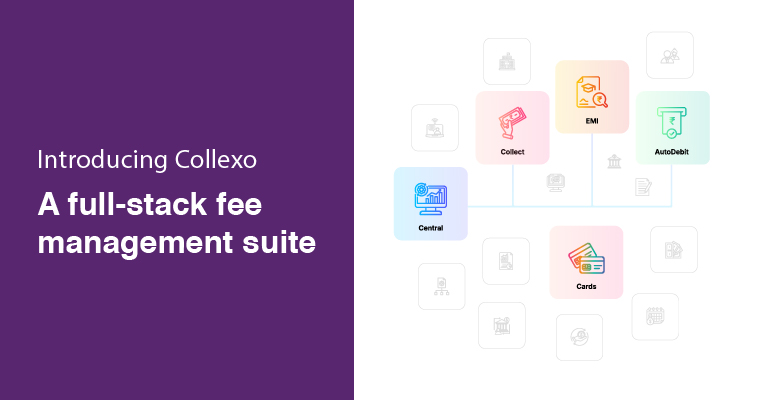
That is why Collexo brings fee setup, collection, payment records, reconciliation, and reporting into one connected system.
What is Collexo?
Collexo is fee management software built for education.
It gives schools, colleges, universities, coaching institutes, and EdTech companies one operating system for every fee collection and management.
Instead of running fee setup, collection, and reconciliation as separate processes, Collexo connects them through one continuous flow:
Manage Fees → Collect Fees → Reconcile & Report
As a result, teams can set up what students need to pay, collect fees through different payment modes, keep every payment linked to the right student, and track what finally reaches the institution.
More importantly, teams do not have to rebuild the context at every stage.
The same fee record can move from amount due to payment, settlement, and reporting.
Why does fee management need more than a payment gateway?
A payment gateway helps process payments.
Fee management needs to handle everything around those payments.
For example, a university may run several programmes across different campuses. Each programme can have its own tuition fee, hostel fee, admission fee, scholarship rules, payment dates, and instalment plans.
At the same time, students may choose different ways to pay.
One student may pay the full amount through UPI. Another may choose EMI. A parent may prefer AutoDebit, while someone else may visit the campus fee counter.
So finance teams need more than a successful payment status.
They need to know:
- What does each student need to pay?
- How much has already been paid?
- What is still due?
- Which fee does each payment belong to?
- Which payment mode was used?
- Has the amount reached the institution?
- Are there any refunds or reversals?
- Are any payments still unmatched?
- Does the student record match the finance record?
When this information sits across spreadsheets, payment gateways, bank statements, and separate fee tools, teams spend more time bringing data together.
Collexo connects these steps instead.
1. Set up fees before collection starts
Good fee collection starts with getting the fee structure right.
However, educational institutions rarely work with one flat fee.
Different programmes, batches, campuses, and students can have different amounts, payment schedules, instalments, scholarships, concessions, and penalties.
With Collexo Fee Management, teams can manage these rules in one place.
They can set up:
- Fee structures and fee heads
- Payment schedules
- Instalments
- Scholarships and concessions
- Taxes and penalties
- Student dues
- Payment reminders
- Receipts
Because the fee setup stays connected to collection, teams do not need to recreate the amount when it is time for the student to pay.
For example, if a student has an approved scholarship, the updated amount can stay part of the same fee record.
Similarly, an instalment plan can continue into the payment journey without creating a separate record.
If you are reviewing your current fee setup, read our guide on how to create and manage a fee structure.
2. Collect fees through the right payment mode
Once a fee becomes due, students and parents need a simple way to pay.
Still, one payment mode will not work for everyone.
With Collexo Fee Collection, institutions can bring different payment modes into the same collection system.
These can include:
- Online payments
- UPI
- Cards
- Net banking
- Payment links
- AutoDebit
- EMI
- Dynamic QR
- Offline payments
- International payments
For instance, one student may pay through UPI while another uses a payment link sent by the institution.
Even though the payment modes are different, both payments can stay linked to the correct student and fee.
As a result, adding more ways to pay does not have to create more scattered records.
UPI also supports QR-based payments and instant bank-to-bank transfers. You can read more about how UPI works on the NPCI website.
For institutions, however, the bigger value comes from keeping the payment context connected:
Student → Fee → Payment Mode → Transaction → Receipt
3. Automate recurring fee collection
Many fees are collected more than once.
Schools may collect tuition monthly or term-wise. Universities may offer semester instalments. Coaching institutes may collect programme fees over several payment dates.
As a result, teams often spend a lot of time sending the same reminders again and again.
Collexo AutoDebit helps reduce that work by using an approved mandate for recurring payments.
Teams can set:
- The amount
- Fee heads
- Payment frequency
- Debit dates
- Student or payer details
- Pre-payment communication
Then, payments can follow the planned schedule.
At the same time, teams can track which payments were completed and which ones still need attention.
This means counsellors or finance teams do not have to manually follow up before every planned payment.
Instead, they can focus on failed, pending, or cancelled payments.
NACH supports recurring and regular electronic transactions in India. For more details, see NPCI’s guide to NACH.
4. Give students more ways to manage high-value fees
Large programme or tuition fees can be difficult to pay in one go.
Therefore, some students and families may prefer to split the amount into smaller payments.
With Collexo EMI, institutions can offer EMI as part of the fee collection journey.
Students can explore available payment plans and choose an option that works for them.
Meanwhile, the institution can keep the payment linked to the same student and fee record.
So EMI does not have to become a separate process outside the fee management system.
The journey remains connected:
Student → Fee → EMI Option → Payment Status → Collection Record
This gives students another way to pay while keeping the fee record clear for the institution.
5. Bring campus payments into the same system
Not every payment happens online.
Students and parents may still visit the campus to clear a fee or make an admission payment.
However, counter payments can create extra work when finance teams cannot quickly identify who made the payment or what the payment was for.
A dynamic QR helps solve this problem.
Instead of using one common QR code for every payment, the institution can create a payment request against a specific:
Student → Fee Head → Amount
The student or parent can then scan the QR and pay through UPI.
Because the payment already has the right context, it can stay linked to the correct fee record.
As a result, finance teams have less manual payment mapping to do later.
This also brings campus collections into the same fee collection system as online payments, recurring payments, and other payment modes.
6. Keep every payment linked to the right student
A payment record should show more than the amount collected.
It should also tell the institution who paid, what the payment was for, and what remains due.
For example, suppose a student needs to pay ₹80,000 in programme fees and ₹20,000 in hostel fees.
Seeing a ₹1,00,000 payment alone is not enough.
The complete record should show:
Student → Fee Heads → Amount Due → Amount Paid → Receipt → Balance
This becomes even more important when something changes later.
For instance, the student may cancel hostel accommodation and become eligible for a refund.
In that case, the original payment should remain in the record. The refund should be recorded as a separate event.
Otherwise, changing the original payment can make the final balance look correct while making the payment history wrong.
Our guide on fee refund management explains how institutions can handle such cases while keeping fee records accurate.
7. Match payments with settlements
A successful payment does not always mean the finance work is complete.
After the student pays, teams still need to check what reached the institution.
For example, they may need to confirm:
- How much did the student pay?
- Which fee did the payment cover?
- Has the amount been settled?
- Which bank account received it?
- Were any charges deducted?
- Was any amount refunded or reversed?
- Are any payments still unmatched?
This is where payment reconciliation becomes important.
With Collexo Fee Payment Reconciliation, institutions can connect student payments with settlement and finance records.
Teams can track:
- Payments
- Outstanding dues
- Settlements
- Refunds
- Reversals
- Unmatched payments
- Other payment issues
Instead of checking several reports for every payment, teams can focus on the cases that actually need action.
As a result, routine matching takes less manual effort.
8. Give finance teams one clear view
Separate systems do more than create extra work.
They also make simple questions harder to answer.
For example:
How much have we collected?
What is still due?
Which programmes have higher outstanding fees?
Which payment methods are students using?
Which settlements are still pending?
Where do finance teams need to take action?
When fee management, collection, and reconciliation work with connected data, reporting becomes clearer.
Finance and leadership teams can see dues, collections, payments, settlements, and exceptions in one place.
They can also move from a high-level view to the campus, programme, fee head, student, or payment that needs attention.
Therefore, reporting becomes part of everyday fee management rather than a separate exercise at the end of the month.
What does connected fee management look like?
Collexo connects each stage of the fee journey.
Manage fees
Set up fee structures, schedules, instalments, scholarships, concessions, taxes, penalties, and reminders.
Collect every way
Give students and parents several ways to pay across online, offline, recurring, EMI, international, and campus channels.
Automate collections
Use AutoDebit, payment reminders, payment links, and receipts to reduce routine work.
Keep records connected
Link each payment to the correct student, fee head, amount, receipt, and balance.
Reconcile and report
Track settlements, refunds, reversals, dues, unmatched payments, and other issues from the same system.
Together, these stages create one connected flow:
Fee Setup → Student Dues → Collection → Payment Record → Settlement → Reconciliation → Reporting
From separate fee processes to one connected system
Many institutions still use one system to set up fees, another to collect payments, spreadsheets to track dues, gateway reports to check transactions, and bank statements to match settlements.
Each tool may solve one task.
However, the institution still has to connect everything.
Collexo brings these parts together.
Fee setup connects to collection. Collection connects to the student record. Payments connect to settlements. Finally, reconciliation connects those records back to reporting.
As a result, context does not have to disappear every time the fee moves to the next stage.
That is what makes Collexo more than another payment tool.
One operating system for every fee collection and management.
From deciding what a student needs to pay to understanding what finally reached the institution, Collexo keeps the complete fee journey connected.
Explore Collexo to see how you can bring fee collection and management into one connected system.