
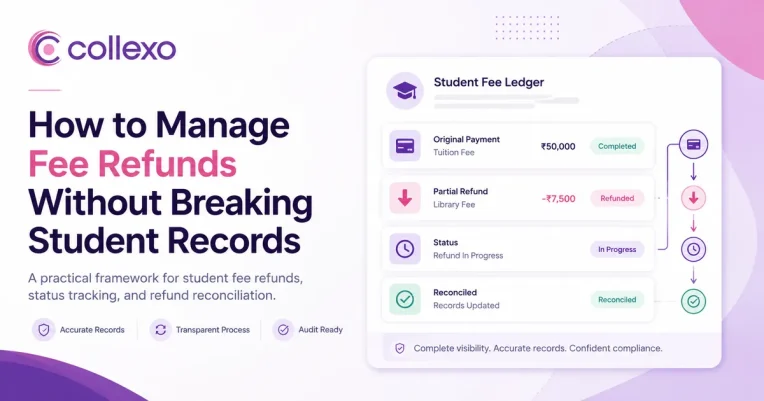
Fee refund management becomes complicated when returning the money is easy, but keeping the student record correct is not.
Consider a student who pays ₹80,000 and later needs a ₹20,000 refund because they cancel hostel accommodation.
Finance can start the refund quickly. However, the institution still needs to keep the original ₹80,000 payment intact, connect the ₹20,000 refund to the hostel fee, update the student’s balance, track the refund until the money actually moves, and reconcile the transaction afterwards.
If someone simply changes the student’s original payment from ₹80,000 to ₹60,000, the balance may look right.
The payment history is now wrong.
That is the core challenge with fee refunds.
A refund should change the student’s balance without changing the history of how that balance was created.
For education institutions, this means treating a refund as a new financial event rather than editing an old one.
This guide explains how to build a cleaner student fee refund process, manage common exceptions, and keep payments, refunds, ledgers, and reconciliation records aligned.
What is fee refund management?
Fee refund management is the process of calculating, approving, processing, tracking, and reconciling money returned against a student’s fee payment while keeping the full payment history intact.
A good refund process should answer seven questions:
- Which student is receiving the refund?
- Which original payment does the refund belong to?
- Which fee head is being refunded?
- Why is the money being returned?
- Who approved the refund?
- Has the money actually reached the payer?
- Has finance reconciled the refund with the student record?
If any of these links breaks, a simple refund can become a reconciliation problem.
That is why refund management belongs inside the broader fee management workflow, not in a separate spreadsheet maintained after the payment is complete.
The biggest refund mistake: rewriting the original payment
Suppose a student paid:
| Fee head | Amount paid |
|---|---|
| Tuition | ₹60,000 |
| Hostel | ₹20,000 |
| Total | ₹80,000 |
Later, the student cancels hostel accommodation and qualifies for a ₹20,000 refund.
A weak process may simply change the student’s total paid amount from ₹80,000 to ₹60,000.
The screen now looks correct.
However, the institution actually received ₹80,000 and later returned ₹20,000.
Those are two separate events.
The record should therefore look like this:
₹80,000 received
↓
₹20,000 hostel refund
↓
₹60,000 net retained
The original payment should remain visible because it still happened.
Similarly, the refund should remain visible because it explains why the student’s current balance changed.
This creates a simple but important rule:
Do not erase the payment because a refund happened. Add the refund as a linked transaction.
A strong student fee management system should preserve both sides of that story.
Refund, reversal, and adjustment are not the same thing
One reason refund records become messy is that teams often use these words interchangeably.
Payment systems do not.
Refund
A refund happens after a successful payment when the institution decides to return some or all of the money.
For example, a student may withdraw from hostel accommodation after paying the hostel fee.
Reversal
A reversal usually follows a payment that did not complete normally.
For example, the student’s bank account may get debited even though the payment fails. In that case, the payment network or bank may reverse the debit.
The Reserve Bank of India separately defines failed payment transactions and their reversal timelines in its framework for authorised payment systems. Read the RBI framework on failed transactions and reversals.
Therefore, finance teams should not treat every returned amount as a merchant refund.
Adjustment
An adjustment changes how the institution uses the money without necessarily sending it back to the student.
For instance, the institution may apply an excess payment against the next semester’s fee.
So:
₹5,000 excess payment → adjusted against next fee demand
is different from:
₹5,000 excess payment → returned to student
Credit balance
A credit balance may exist when the student has paid more than the amount currently due.
The institution may later refund or adjust that credit based on policy.
These distinctions matter because each event affects the student ledger differently.
A system that labels everything simply as Refunded loses useful financial information.
Why fee refunds become messy so quickly
The main problem is timing.
The institution, payment provider, bank, and student record do not always update at the same moment.
For example:
11:00 AM: Finance approves the refund
11:02 AM: Refund request goes to the payment provider
11:05 AM: Provider marks it as processing
Two days later: Money reaches the payer
At what point should the institution call the refund complete?
Certainly not at 11:02 AM.
Payment providers themselves use several refund states. Cashfree, for example, documents refund statuses such as pending, successful, failed, cancelled, and on hold. It also supports full and partial refunds. See Cashfree’s refund documentation.
As a result, institutions should separate these stages too.
Refund requested ≠ refund approved ≠ refund initiated ≠ refund completed ≠ refund reconciled
That distinction prevents one of the most common student-service problems: telling someone that a refund is complete when the money is still being processed.
A better fee refund management workflow
A good refund workflow should connect the decision, payment, student record, and final reconciliation.
Here is what that process should look like.
1. Start with the reason for the refund
Before finance starts a refund, identify why the money needs to move.
Common cases include:
- Admission withdrawal
- Programme withdrawal
- Hostel cancellation
- Transport cancellation
- Duplicate payment
- Excess payment
- Scholarship approved after payment
- Concession approved after payment
- Course or campus change
- Incorrect fee allocation
- Security deposit return
- Failed transaction reversal
The reason matters because not every case requires the same action.
For example, a duplicate payment may need a direct refund. However, a programme change may require an adjustment rather than sending the money back.
So the first question should not be:
“How do we refund this?”
It should be:
“What happened, and what should happen to the money?”
2. Connect the refund to the right fee head
A student’s total payment is not always the refundable amount.
Suppose the institution collected:
| Fee head | Amount |
| Tuition | ₹80,000 |
| Hostel | ₹25,000 |
| Transport | ₹10,000 |
| Security deposit | ₹5,000 |
| Total | ₹1,20,000 |
Now assume the student cancels transport.
The institution needs to refund ₹10,000.
However, simply reducing the student’s overall payment by ₹10,000 is not enough.
The refund should stay connected to Transport.
The ledger should show:
| Fee head | Paid | Refunded | Net |
| Tuition | ₹80,000 | ₹0 | ₹80,000 |
| Hostel | ₹25,000 | ₹0 | ₹25,000 |
| Transport | ₹10,000 | ₹10,000 | ₹0 |
| Security deposit | ₹5,000 | ₹0 | ₹5,000 |
Now anyone looking at the record can understand what changed.
This also makes reporting easier later.
Instead of only knowing that the institution refunded ₹10,000, finance can see why.
3. Keep the original transaction attached
Every refund should point back to the original payment.
At minimum, the institution should be able to trace:
Student → fee head → original payment → payment reference → refund amount → refund reference → final status
This becomes especially important with partial refunds.
Suppose a student made one ₹50,000 payment.
Later:
- ₹10,000 gets refunded in August
- another ₹5,000 gets refunded in September
The institution should keep both refunds linked to the original ₹50,000 payment.
Otherwise, it becomes difficult to answer a basic question:
How much of this payment has already been refunded?
Payment providers support this model too. Cashfree, for instance, documents both partial refunds and multiple partial refunds while ensuring the total does not exceed the original payment.
For institutions, the same principle should apply to the student ledger.
4. Separate approval from refund processing
An approved refund does not mean the money has moved.
That sounds obvious. Yet many manual refund processes blur the two.
A cleaner workflow looks like this:
Requested → Verified → Approved → Initiated → Processing → Completed → Reconciled
Each stage answers a different question.
Requested: Has someone raised the case?
Verified: Has finance checked the amount and eligibility?
Approved: Has the right authority approved it?
Initiated: Has the institution sent the refund for processing?
Processing: Is the provider still handling it?
Completed: Has the refund reached a successful final state?
Reconciled: Does the refund match the institution’s financial records?
This helps both finance teams and student-facing teams.
For example, a counsellor should not tell a student:
“Your refund is complete.”
when finance only knows:
“Your refund has been initiated.”
A small status difference can prevent a large trust issue.
5. Keep the approval trail
Refunds involve money leaving the institution.
Therefore, they need stronger controls than a simple status change.
A refund record should capture:
- Student
- Original payment
- Fee head
- Amount requested
- Amount approved
- Refund reason
- Requesting user
- Approving user
- Approval date
- Notes or documents
- Refund method
- Refund reference
- Current status
This does not mean creating a long approval process for every refund.
Instead, the goal is simple:
Anyone reviewing the transaction later should be able to understand what happened without searching through email threads.
Refund reconciliation is where the process actually ends
Many teams think of reconciliation only in terms of money coming into the institution.
However, money going out needs reconciliation too.
Suppose the system shows:
Refund approved: ₹20,000
The payment provider shows:
Refund successful: ₹20,000
The student ledger shows:
Refund: ₹20,000
And the matching financial movement confirms the same amount.
Now the refund has a complete trail.
That is refund reconciliation.
A useful refund reconciliation process should answer:
What did the institution collect?
↓
What amount did it decide to return?
↓
What refund did the provider process?
↓
What bank movement followed?
↓
Which student and fee head did it belong to?
↓
Does the student ledger now show the correct balance?
This is why refunds should connect directly with fee payment reconciliation.
If collection, refund, and reconciliation live in separate systems, finance teams have to rebuild these links manually.
Seven refund exceptions institutions should design for
Straightforward refunds are rarely the real problem.
Exceptions are.
A strong fee refund management process should handle these cases without losing the student record.
1. Duplicate payment
A student or parent attempts the same fee payment twice, and both transactions succeed.
What can go wrong:
Finance removes one payment without keeping the original payment references.
Better approach:
Keep both successful transactions. Then refund the exact duplicate payment and retain the valid one.
2. Partial refund across several fee heads
A student pays tuition, hostel, and transport in one transaction but later cancels transport.
What can go wrong:
Finance refunds ₹10,000 against the overall payment without showing which fee changed.
Better approach:
Link the refund to the Transport fee head.
As a result, the student ledger still explains the student’s current balance.
3. Refund initiated but still pending
Finance starts the refund, but the payment provider still shows it as processing.
What can go wrong:
The institution tells the student that the refund is complete.
Better approach:
Keep the status as Initiated or Processing until the provider reports a successful final state.
4. Refund fails after approval
The institution approves the refund, but the transaction fails during processing.
What can go wrong:
Someone creates another refund without checking the first attempt.
That can create duplicate processing.
Better approach:
Keep the failed refund linked to the same case. Then verify the provider’s status before retrying.
5. A reversal gets mistaken for a refund
The student’s account gets debited, but the payment itself fails.
The bank later reverses the transaction.
What can go wrong:
Finance starts another manual refund.
Better approach:
First check whether the original transaction succeeded.
If it failed, the event may belong to the reversal workflow rather than the student fee refund process.
6. The student changes programme or campus
A student has already paid but moves to another programme or campus.
What can go wrong:
The institution refunds the full amount and collects it again, even when its policy allows an internal adjustment.
Better approach:
Decide whether the case needs a refund, transfer, or adjustment before processing the money.
7. The policy and the system disagree
Admissions tells the student one refund amount.
Finance calculates another.
The institution’s published policy says something else.
Now the problem is bigger than payment processing.
UGC requires relevant higher education institutions to follow applicable fee-refund rules and communicate them appropriately to students. Institutions should therefore check the latest rule that applies to them rather than treating refund policy as an informal finance decision. See UGC’s fee refund policy notice.
The technology lesson is simple:
The refund workflow should apply the institution’s approved policy consistently. It should not recreate the policy manually for every student.
The student ledger should tell the full story
A student ledger should answer more than:
How much has this student paid?
It should answer:
What was charged, what was paid, what changed, what was refunded, and what remains due?
For example:
| Date | Event | Fee head | Amount | Status |
| 12 Jun | Payment | Tuition | +₹60,000 | Successful |
| 12 Jun | Payment | Hostel | +₹20,000 | Successful |
| 04 Jul | Refund | Hostel | -₹20,000 | Completed |
| 06 Jul | Reconciliation | Hostel refund | ₹20,000 | Matched |
This tells a complete story.
The institution received ₹80,000.
Later, it returned ₹20,000.
The student’s net paid amount is now ₹60,000.
More importantly, the system can explain why.
Compare that with a record that simply says:
Total paid: ₹60,000
The number may be right.
The history is missing.
Fee refund management should focus on exceptions, not spreadsheets
Refund volumes are often lower than payment volumes.
Because of that, institutions may assume spreadsheets are good enough.
However, lower volume does not mean lower risk.
Refund cases often contain more variation than normal collections.
One refund may involve a duplicate payment.
Another may involve a hostel cancellation.
A third may involve a failed UPI transaction.
A fourth may involve an adjustment across semesters.
Therefore, finance teams should not spend most of their time checking normal refunds.
The system should surface the cases that need attention:
- Refund pending for too long
- Refund amount differs from approved amount
- Refund has no original payment attached
- Refund exceeds the available refundable amount
- Duplicate refund request
- Refund failed
- Refund completed but not reconciled
- Student ledger does not match the refund record
This changes the operating model.
Instead of:
Finance checks every refund manually
the institution moves toward:
The system tracks normal refunds. Finance handles exceptions.
That is a much more scalable way to manage student refunds.
A good fee system should preserve both sides of the payment
Education payment systems often get evaluated on how easily they collect money.
UPI.
Cards.
Payment links.
AutoDebit.
QR payments.
Offline payments.
EMI.
However, the quality of the underlying system becomes much clearer when money needs to move in the other direction.
A strong fee collection system should not stop at Payment Successful.
It should preserve the relationship across the full lifecycle:
Fee created → Payment collected → Receipt recorded → Refund or adjustment → Settlement → Reconciliation → Student ledger
When those records stay connected, finance teams spend less time rebuilding the history later.
For a broader look at that lifecycle, read our guide to student fee management from setup to reconciliation.
The goal is not simply faster refunds
Students care about getting their money back on time.
Finance teams care about keeping records accurate.
Institutions need both.
A good fee refund management process should make it easy to answer:
- What did the student originally pay?
- What amount did the institution refund?
- Why did it refund that amount?
- Which fee head changed?
- Who approved the refund?
- What is the current processing status?
- Has the refund reached a final state?
- Has finance reconciled it?
- What is the student’s balance now?
If the institution can answer those questions from one connected record, the refund process is working.
If teams need a payment dashboard, a spreadsheet, an email thread, and the student ledger just to reconstruct the same refund, the process is not working.
That is the difference between processing a refund and managing a refund properly.
Simplify fee refunds with Collexo
Collexo connects fee management, fee collection, and payment reconciliation across the student fee lifecycle.
That means refund and adjustment records can stay connected to the student, original payment, fee head, and ledger instead of becoming separate finance entries that teams have to match later.
Simplify fee refunds without losing the payment trail.
Schedule a demo of Collexo Payment Cloud.
Frequently asked questions about fee refund management
What is a student fee refund?
A student fee refund is money returned against a fee payment that the institution previously collected. Depending on the case and the institution’s refund policy, the refund may cover the full payment or only part of it.
What is fee refund management?
Fee refund management is the process of calculating, approving, processing, tracking, and reconciling refunds while keeping the original student payment and fee records intact.
What is the difference between a refund and a reversal?
A refund generally follows a successful payment and starts when the institution decides to return money. By contrast, a reversal often follows an unsuccessful or incomplete payment and may happen through the bank or payment network.
Should institutions delete the original payment after a refund?
No. Keep the original payment and add the refund as a separate linked transaction. This preserves a clear financial trail and explains how the student’s current balance was calculated.
Can an institution issue a partial fee refund?
Yes, depending on its policy and payment setup. The institution should link the partial refund to the original payment and, where relevant, the specific fee head.
When should a refund be marked complete?
Do not mark a refund complete simply because someone initiated it. The payment provider may still show the transaction as pending or processing. Move it to completed only after it reaches a successful final state.
What is refund reconciliation?
Refund reconciliation checks whether the approved refund, payment provider record, matching bank movement, and student ledger all show the same transaction and amount.
How can institutions reduce fee refund errors?
Keep every refund linked to the original payment, connect it to the correct fee head, separate approval from processing, track intermediate statuses, maintain an audit trail, and reconcile completed refunds before closing the case.