
A student pays ₹85,000. A reliable student fees record should show much more than whether that payment succeeded.
The parent receives a fee receipt, and the student account shows the fee as paid. At first, the transaction looks complete.
Months later, however, the finance team may need to answer a different set of questions. What exactly did the ₹85,000 cover? Which fee demand did the payment close? When did the institution receive the money? Did someone later adjust, reverse or refund part of it?
A PDF receipt alone cannot answer all of those questions.
That is an important distinction for education finance teams:
A fee receipt confirms a payment. A fee record explains the financial history behind it.
As schools, colleges, universities, coaching institutes and EdTech businesses add more payment channels and flexible fee plans, this distinction becomes increasingly important.
The goal is not simply to store more documents. Instead, finance teams need to make every rupee traceable from the amount due to the payment received and, finally, to the money settled.
What should a student fees record contain?
A fee record is the financial history of what a student needed to pay, what they actually paid and what changed afterwards.
Importantly, that history does not begin when the institution generates a receipt.
It begins when the institution creates the fee obligation.
The fee structure, fee head, amount, payment schedule, due date and any scholarship or concession give every later payment its context. Once the student pays, the institution needs to connect that payment with the right student and fee demand.
After that, the record continues through the receipt, settlement and any later refund, reversal or adjustment.
In practice, a complete finance trail connects several records:
| Record | What finance should be able to understand |
|---|---|
| Fee demand | What the institution charged, for which fee head and when it became due |
| Payment record | How much the student paid, when they paid and through which mode |
| Fee receipt | What payment the institution acknowledged to the student or parent |
| Student fee history | How dues, payments, concessions and balances changed over time |
| Settlement record | Whether the institution received the collected amount |
| Refund or reversal record | What changed after payment and why |
| Change history | Who made or approved an important financial change and when |
Together, these records create a student fees record that explains both the current balance and the financial activity behind it.
This is also why fee management should begin before collection. A clearly defined fee structure makes later payments easier to allocate, track and explain.
For a closer look at this stage of the lifecycle, see Collexo Fee Management.
A fee receipt matters, but it is not the complete financial history
A fee receipt serves an important purpose.
It gives the student, parent or payer evidence that the institution has recorded a payment. Government education documentation also uses receipts as evidence of fees paid. For example, the Ministry of Education has published scholarship documentation that includes specimen receipts for tuition and hostel fees.
However, the student’s financial history rarely ends when the institution generates a receipt.
Imagine that the same student later receives a scholarship, gets an approved concession, changes hostel accommodation, pays another instalment or receives a partial refund.
The original receipt still describes what happened when the student made the payment.
Meanwhile, the student fees record needs to explain what happened afterwards too.
This leads to a useful principle:
Do not let the latest balance erase the financial history that created it.
For example, two students can both show an outstanding balance of ₹65,000 while having completely different financial histories.
One may have received a ₹20,000 scholarship.
Another may have paid the full amount before receiving a ₹20,000 refund.
A third may simply have another ₹20,000 instalment left to pay.
The current balance can look identical.
The financial story behind it is not.
Think of every fee transaction as a connected evidence chain
Instead of treating fee receipts, payment reports and settlement reports as separate outputs, finance teams can view each transaction as one connected financial chain.
It starts with a simple question:
What should the student have paid?
The fee demand provides this context. It should identify the student, fee head, amount, due date, payment schedule and any applicable scholarship or concession.
What did the student actually pay?
Next, the payment record should capture the amount, payment date, payment mode and transaction reference.
What did the institution acknowledge?
The fee receipt confirms the payment recorded against the student.
Therefore, finance should be able to move directly from a receipt to the underlying transaction instead of treating the receipt as a standalone document.
What happened to the money?
A successful student payment does not necessarily mean the finance process has ended.
Finance may still need to confirm when the payment settled, how much the institution received and whether the payment provider deducted applicable charges.
What changed afterwards?
Finally, refunds, reversals, concessions and corrections should remain connected to the original transaction.
Together, these events create a simple financial chain:
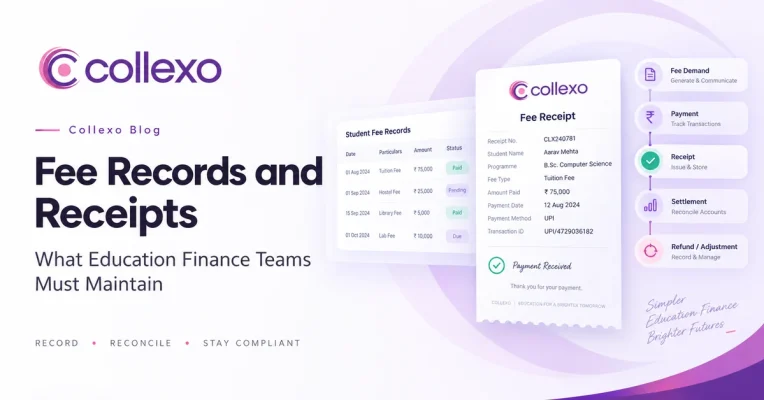
Fee demand → Payment → Receipt → Settlement → Refund or adjustment
A connected student fees record makes that sequence easier to trace.
As a result, finance teams can move forwards or backwards through a transaction without searching multiple spreadsheets, payment dashboards and folders.
This same principle supports effective student fee reconciliation. When the fee demand, transaction, receipt, settlement and student record remain connected, finance can verify the complete transaction rather than checking only whether the payment succeeded.
What should a fee receipt contain?
There is no single fee receipt format that works for every educational organisation.
Required information can vary according to the institution, its legal structure, tax position and internal finance policies.
Still, a useful receipt should help someone identify and understand the payment without first searching another system.
| Field | Why it matters |
|---|---|
| Institution or legal entity | Shows who received the payment |
| Unique receipt number | Gives the receipt a traceable reference |
| Receipt date | Shows when the institution acknowledged the payment |
| Student name and ID | Connects the payment with the correct learner |
| Programme, class, batch or academic period | Adds academic context |
| Fee head | Explains what the student paid for |
| Amount paid | Records the acknowledged payment amount |
| Payment mode | Shows how the student paid |
| Transaction or reference ID | Connects the receipt with the underlying payment |
| Applicable tax details | Records tax information where relevant |
| Payment status | Confirms the state of the transaction |
| System or issuer reference | Identifies where the receipt originated |
Institutions should treat these as practical record fields rather than a universal legal receipt template.
Finance, tax and audit teams should determine which additional statutory fields apply to their organisation.
A strong fees record preserves events, not just balances
Consider a simple student fee history.
A tuition fee of ₹1,00,000 becomes due on 1 July. The student pays ₹50,000 on 15 July. On 1 August, the institution approves a ₹10,000 scholarship. The student then pays another ₹40,000 on 15 August. Later, the institution approves a ₹5,000 refund against another fee component.
The finance team should not focus only on whether the latest balance is mathematically correct.
It should preserve the sequence that created that balance:
₹1,00,000 demand → ₹50,000 payment → ₹10,000 scholarship → ₹40,000 payment → ₹5,000 refund
This becomes particularly important when finance teams process refunds, reversals and corrections.
For example, simply editing an old payment amount may make today’s balance look correct. However, the change can make the original payment record inaccurate.
A better approach keeps both events visible.
That is also why a refund should generally appear as a new financial event connected with the original payment rather than as an unexplained change to historical data.
Collexo explores this problem further in its guide to fee refund management.
Record the change instead of rewriting the past
Suppose an institution initially records a payment of ₹80,000.
Later, it returns ₹20,000 to the student.
If someone changes the original payment from ₹80,000 to ₹60,000, the latest figure may look correct. However, the record no longer explains what actually happened.
A stronger history would show:
Original payment: ₹80,000
Refund: ₹20,000
Net amount retained: ₹60,000
Now finance can explain both the original payment and the later refund.
When the fees record preserves both events, teams do not need to rebuild the history manually to understand the current amount.
This principle also matters for financial controls.
For GST-registered persons, CBIC’s Accounts and Records rules address electronic records, backups and logs relating to edited or deleted entries. The rules also cover the ability to produce an audit trail and links between source documents and financial accounts where required.
Institutions can refer to the official CBIC Accounts and Records rules.
Not every educational institution has the same GST position. Therefore, institutions should confirm their own statutory obligations with their finance, tax and audit advisers.
Still, the wider finance principle applies:
Your financial history should explain changes, not hide them.
Can your fees record pass the 25-transaction test?
Finance leaders can use a simple exercise to test whether their records work in practice.
Select 25 student payments at random from the previous academic year.
For each transaction, check whether the team can quickly find:
- The original fee demand and amount due.
- The student and relevant fee head.
- The payment amount, date and transaction reference.
- The fee receipt generated for the payment.
- The student’s updated fee history.
- The settlement or bank-side record.
- Any later refund, reversal, concession or adjustment.
- The history of significant changes or approvals.
Then ask one more question:
How many systems, spreadsheets and people did the team need to involve?
This is where the exercise becomes useful.
An institution may technically have every record and still struggle to use them.
For example, if one transaction requires three people, four exports and several hours of manual checking, the problem is no longer record availability.
The problem is record connection.
A connected fees record makes this evidence easier to retrieve when finance, management or auditors need it.
Audit readiness does not simply mean that information exists somewhere.
Instead, finance teams should be able to reconstruct the story of a transaction quickly, consistently and with supporting evidence.
Seven questions every strong fee record should answer
A reliable financial record should make seven things clear.
Who needed to pay?
Finance should be able to identify the student and, where relevant, the payer.
What did they need to pay for?
The record should show the relevant fee head, programme, class, term or service.
How much did they owe?
Teams need visibility into the original amount due as well as any approved scholarship, concession or adjustment.
How much did they actually pay?
The payment value, date, mode and transaction reference should remain easy to trace.
Which fee receipt did the institution issue?
The receipt should connect directly with the underlying payment rather than living as an unrelated document.
Did the institution receive the money correctly?
Finance should be able to connect the student’s payment with the related settlement.
What changed later?
Any refund, reversal, concession or correction should add to the financial history rather than replacing it.
If the team has to reconstruct one of these answers manually, the institution has a gap in its records.
More payment channels make connected records even more important
Education institutions rarely collect fees through one route anymore.
Students and parents may pay through an online checkout, payment link, UPI, recurring mandate, EMI option, dynamic QR, campus counter, bank transfer, offline payment mode or international payment method.
More choice can improve the payment experience.
However, it can also split one student’s financial information across several systems.
A gateway may hold the transaction. A spreadsheet may hold an offline collection. A bank file may hold the settlement. Meanwhile, another system may show only the student’s latest outstanding balance.
The student fees record should remain the common link regardless of how the student chooses to pay.
UPI is a payment method.
A payment gateway processes a transaction.
A settlement moves funds to the institution.
The student and underlying fee obligation connect them.
This is why multi-channel fee collection should do more than give families more ways to pay. It should also connect each payment back to the right learner, fee head and financial record.
See how Collexo supports different payment routes through education fee collection.
Payment success and financial closure are not the same thing
A green Payment Successful screen tells you that the payer completed a transaction.
It does not necessarily tell the finance team that its work is complete.
Finance may still need to map that payment to the correct learner, apply it against the right fee head, check the gateway transaction, follow the settlement, account for charges or investigate an exception.
Therefore, the workflow should continue beyond payment success.
Consider a simple example.
A student pays ₹10,000.
The payment provider records a ₹10,000 transaction.
Later, the institution receives ₹9,900 after applicable charges.
Both numbers may be correct.
However, finance needs a clear connection between them.
Without it, the student’s payment history says ₹10,000 while the bank-side record says ₹9,900. Someone then has to explain the difference manually.
A connected fees record gives finance the context to understand both values.
That is why reconciliation belongs inside the fee-record conversation, not after it.
How long should education institutions maintain fee records?
There is no responsible universal answer such as:
“Every educational institution must keep fee receipts for exactly X years.”
The correct retention period can depend on the organisation’s legal structure, tax registrations, applicable laws, contracts and any ongoing assessment or investigation.
For example, Section 128 of India’s Companies Act includes record-retention requirements for companies to which it applies. GST law also contains separate requirements for registered persons.
Therefore, one generic retention period should not simply be copied across every school, university, coaching business or EdTech company.
Finance leaders should establish a written record-retention policy with their audit, legal and tax advisers.
Where applicable, teams can review the Companies Act, 2013 on India Code.
At an operational level, however, one principle applies widely:
Keep records searchable, readable, connected and recoverable for the full period in which your organisation needs to retain them.
A seven-year-old receipt sitting in a folder has limited value if nobody can connect it to the student, original fee, payment, settlement and later adjustment.
Audit readiness starts long before an auditor asks for a receipt
Finance teams sometimes treat audit preparation as a year-end exercise.
In reality, audit readiness depends on how the institution records transactions throughout the year.
If teams preserve fee demands, payments, receipts, settlements and later changes as they happen, they can answer questions much faster.
By contrast, disconnected records force teams to recreate financial history afterwards.
Someone downloads the payment file. Another person checks the student ledger. A third team finds the receipt. Finance then compares everything with the bank record.
Even when every number eventually matches, the institution has spent unnecessary time proving something its system should already explain.
A well-maintained fees record reduces that reconstruction work because the evidence remains connected from the beginning.
So instead of asking only:
“Do we have the receipt?”
Finance leaders should ask:
“Can we explain the complete financial journey behind this receipt?”
That is a much stronger test of record quality.
Build the record around the student, not the software
Institutions change payment gateways.
They switch banks.
They add campuses and programmes.
They introduce new payment methods.
They may also change their ERP, SIS or finance systems.
The student’s financial history, however, still needs to remain understandable.
That means the student fees record should answer stable financial questions regardless of which software holds the data.
What did the student owe?
Why did they owe it?
What did they pay?
Which fee did the payment close?
What amount reached the institution?
What changed afterwards?
What remains outstanding?
If a system migration makes those questions impossible to answer, the organisation did not really have a strong financial system of record.
It had data stored inside software.
That difference matters.
Centralisation does not mean putting everything in one table
When teams hear “centralise fee records,” they may imagine one enormous spreadsheet.
That is not the goal.
Different financial events need different records.
A fee demand is not a payment.
A payment is not a settlement.
A refund is not an edit to a payment.
The important thing is that these records connect to each other.
Finance should be able to start with a student and trace the financial journey.
It should also be able to start with a transaction or settlement and trace it back to the correct student and fee.
That is what centralisation should mean:
One connected financial history, even when several records make up that history.
For a broader view of how these stages connect, read Collexo’s guide to the student fee management lifecycle from setup to reconciliation.
Build a fees record finance teams can actually trust
The conversation around fee records often starts too late.
It starts when someone asks:
“Where is the receipt?”
A stronger finance operation starts with a different question:
“Can we explain this student’s complete fee position?”
That shift changes how institutions manage financial information.
Receipts, payment reports, settlements, student balances, refunds and adjustments stop behaving like separate administrative outputs.
Instead, they become connected parts of the same financial history.
A reliable student fees record should tell finance:
What was due. What was paid. What settled. What changed. What remains.
That is the standard finance teams should work towards:
Every fee assigned. Every payment recorded. Every receipt connected. Every settlement matched. Every change preserved.
Not because finance teams need more documents.
Because they need one financial history they can understand and trust.
Centralise your fee records
Collexo connects fee management, fee collection and payment reconciliation so finance teams can follow the financial journey from fee setup and payment through receipts, settlements, refunds and student history.
Explore Collexo Fee Management
Frequently asked questions
What is a fee receipt?
A fee receipt is an acknowledgement that an educational institution provides after recording a student’s payment. It commonly identifies the student, amount paid, payment date, fee purpose and payment reference.
What is the difference between a fee receipt and a fee record?
A fee receipt confirms one payment. A fee record covers the wider financial history, including the original fee, payments, receipts, outstanding balance, settlement, refunds and later adjustments.
What should a student fees record contain?
A student fees record should connect the learner with the original fee demand, fee head, amount due, payments, receipt references, current balance, settlements and any later refunds, concessions or corrections.
What payment records should an educational institution maintain?
Finance teams should be able to connect every payment with the student, fee demand, fee head, amount, payment date, payment mode, transaction reference, receipt and settlement. They should also preserve any later refund, reversal or adjustment.
Should an old fee receipt be deleted after a refund?
Finance teams should generally preserve the original payment history and record the refund or reversal as a separate linked event rather than rewriting the original transaction. Institutions should follow their applicable accounting, legal and tax requirements when defining the exact process.
Why should fee records include settlement information?
A successful student payment and the amount ultimately received by the institution are different stages of the same financial journey. Connecting settlement information helps finance understand differences, deductions, pending settlements and unmatched transactions.
Can educational institutions maintain fee records electronically?
Yes. Organisations commonly maintain financial records electronically. However, records should remain searchable, backed up and easy to trace. Institutions should also comply with any electronic recordkeeping requirements that apply to their legal and tax position.
How long should an educational institution keep fee receipts?
There is no single retention period that applies to every educational organisation. The period depends on the institution’s legal structure and tax obligations. Finance teams should confirm the applicable retention policy with their finance, tax, audit and legal advisers.