
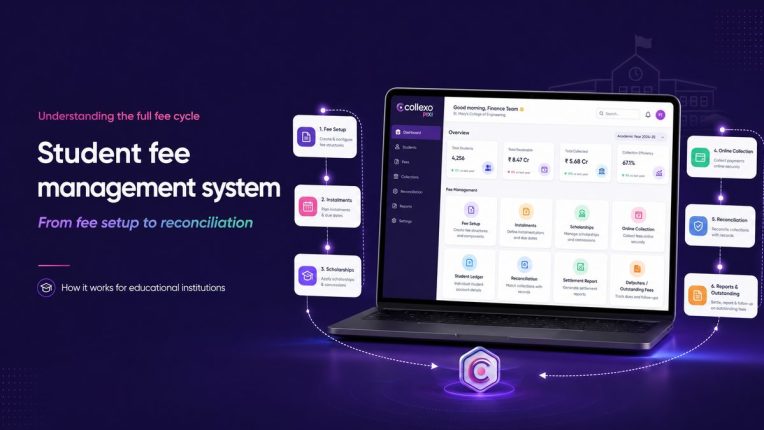
Every academic cycle starts with the same task. Someone has to configure fee structures, collect payments across channels, and match every rupee back to a student record. A student fee management system handles this entire cycle in one connected system. This post walks through what actually happens at each stage, using Collexo’s own fee management, collection, and reconciliation workflow as the reference.
What is a student fee management system?
A student fee management system configures, assigns, invoices, tracks, and manages student fees through one centralised platform. It handles fee structures, payment schedules, scholarships, concessions, penalties, taxes, invoices, receipts, and student fee ledgers according to each institution’s own rules. Collexo extends this further as the operating system for fee collections and payments, connecting fee configuration directly to collection, reconciliation, settlements, and reporting.
This differs from generic accounting software in a specific way. A student fee management system understands fee heads, instalments, scholarships, and academic cohorts as first-class objects, not spreadsheet columns. This means program changes, hostel additions, or scholarship approvals update the student’s fee record automatically instead of triggering a manual edit somewhere else.
Setting up fee structures by programme, campus, and cohort
Fee setup starts with defining fee heads such as tuition, hostel, examination, or transport, each with its own amount, billing cycle, and due date. Institutions then configure separate fee structures by programme, campus, academic year, semester, student category, or any custom cohort. This means a B.Tech 2026 batch and a scholarship cohort within it can carry entirely different fee plans without duplicate manual setup.
Every fee head connects to one ledger per learner, so finance teams see program-wise and campus-wise fees from a single source rather than reconciling separate spreadsheets per department. Because these structures live in the system itself, updating a rule mid-year preserves the existing records and audit trail instead of overwriting history.
Instalments, scholarships, and late fees inside the same system
Large fees rarely get paid in one instalment, so a student fee management system needs to handle part payments cleanly. Institutions configure term-wise, monthly, or custom instalment plans, and the system tracks partial payments, due dates, and outstanding balances for every learner separately. A student paying half a semester fee upfront still has a clear, visible balance rather than an ambiguous entry.
Scholarships and concessions run through rule-based logic tied to academic merit, financial need, sibling policies, or institutional partnerships, with approval workflows attached to each adjustment. Late fees follow the same pattern. Institutions define grace periods and flat or percentage-based penalties once, and the system applies them consistently once a due date passes, with waiver approvals tracked rather than handled ad hoc.
How fee collection works across channels
Collection needs to match how students and parents actually want to pay, not force one channel. A student fee management system typically supports online checkout through UPI, cards, net banking, and wallets, alongside payment links shared over WhatsApp, SMS, or email. AutoDebit handles recurring instalments through eNACH mandates, debiting fees automatically on the due date and alerting parents beforehand.
For counter payments, dynamic QR codes get generated per transaction, locked to a specific student, fee head, and amount, so a scan maps directly to the right record instead of an unidentified bank credit. Offline payments like cash, cheque, or bank transfer get recorded against the same student ledger, and international payments run through supported multi-currency channels for institutions with global applicants. Every one of these payment routes feeds the same fee record, which is what makes reconciliation possible in the first place.
Where fee reconciliation actually gets hard
Reconciliation is the step where manual fee tracking usually breaks down, and it is worth being specific about why. A student fee management system has to match every payment against its fee demand, the payment gateway’s response, the bank settlement, and any refund or reversal, four separate records that all need to agree.
The exceptions that surface are specific and worth naming. A successful payment with no matching fee record. A fee record with no corresponding payment. A settlement that arrives partial or late. A duplicate payment or an unidentified bank transfer that never gets tied to a student. A refund that never made it back into the student ledger. Each of these stays flagged as an open exception until someone resolves it, which turns reconciliation into a short review of genuine anomalies instead of a manual line-by-line match across every transaction.
What reconciliation reporting actually gives finance teams
Once matching runs automatically, reporting becomes the useful output. A student fee management system typically generates collection reports, defaulter lists, settlement reports, and payment-mode reports without manual compilation. Multi-campus institutions get consolidated group-level reporting while individual campuses retain their own entity-level detail, bank accounts, and settlement rules.
Payment routing rules send settlements to the correct account by fee type, campus, or department, which simplifies bank-side reconciliation considerably. An audit trail logs every transaction, refund, and configuration change with a timestamp and user, which matters during audits or disputed adjustments. Cash flow forecasting rounds this out by projecting expected fee inflows by month, programme, or campus, giving finance leadership a planning view rather than just a historical one.
What to look for in a student fee management system
When evaluating a student fee management system, look past collection alone. Confirm it supports fee structures by programme and cohort, not a single flat plan. Check that instalments, scholarships, and late fees run through the same rule engine rather than separate manual processes. Most importantly, confirm reconciliation actually classifies exceptions like unmatched payments and partial settlements, rather than exporting a raw transaction list for someone to sort through by hand.
Collexo runs this entire cycle, fee management, collection, and reconciliation, as one connected workflow rather than three disconnected tools. It works across more than 700 educational institutions today, managing over 3 million students and processing more than 1 billion dollars in fees annually across over 6,000 users. If you are still comparing options at a category level, our best fee management software for educational institutions guide covers the full buying framework.
Want to see how a student fee management system works for your institution’s fee cycle? Schedule a demo and see how fee setup, collection, and reconciliation fit together in practice with Collexo.