
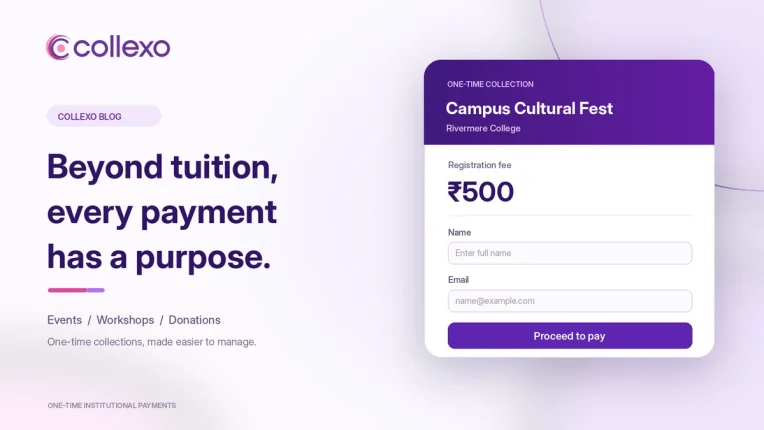
Payment pages for educational institutions address a gap that many campuses overlook: collecting occasional fees without losing track of who paid, what they paid for, and how those payments should be accounted for.
A university might have an efficient system for collecting tuition fees, managing instalments, and tracking student dues. Yet when its annual cultural festival comes around, the organising team may still find itself sharing QR codes, collecting registrations through forms, and maintaining a separate spreadsheet of payments.
The same happens with workshops, conferences, alumni contributions, and other occasional institutional collections.
Although these payments may be smaller than tuition fees, the administrative effort can be disproportionately high. Someone needs to identify who paid, verify the amount, track registrations, resolve unsuccessful transactions, and eventually hand over an accurate collection report to finance.
The issue isn’t necessarily the payment method. It’s the lack of a structured process connecting each payment to its purpose.
That’s where payment pages become valuable.
What are payment pages for educational institutions?
Payment pages for educational institutions are customisable online payment interfaces that allow schools, colleges, and universities to collect fees for specific purposes, such as event registrations, workshops, donations, and miscellaneous institutional charges.
Unlike individual payment requests, a single payment page can be shared with multiple payers through a common link or QR code. It can capture relevant payer information, support fixed or flexible payment amounts, and help institutions monitor collections against defined limits or goals.
More importantly, payment pages bring structure to collections that don’t always fit into regular student fee workflows.
Digital payments have grown. But have institutional processes kept pace?
India’s payment infrastructure has undergone a remarkable transformation.
According to the Ministry of Finance’s August 2026 update on UPI, the platform processed more than 24,162 crore transactions in FY 2025–26.
This widespread adoption has changed how people expect to pay. A parent registering for a school workshop or an alumnus contributing to a fundraising initiative increasingly expects to complete the transaction digitally, without visiting an accounts office.
However, accepting a digital payment and managing that collection effectively are two different things.
Consider a college organising a three-day entrepreneurship summit.
It shares a QR code for the ₹1,000 registration fee. Participants pay through their preferred UPI applications, while organisers collect names and contact details separately.
The transactions go through, but several questions remain.
Which participants have completed their payments? Which transactions belong to the summit rather than another campus activity? Has anyone paid twice? How many confirmed registrations remain before the event reaches capacity?
Most importantly, can finance generate an accurate event-wise collection report without manually matching payment references?
The digital payment infrastructure has done its job. The institutional collection process still needs work.
The next phase of digital fee collection isn’t simply about enabling more payment methods. It’s about preserving the context of every payment, from initiation to financial reporting.
Why one-time fee collection needs a different approach
Most institutional fee management processes are designed around predictable financial obligations.
A student is enrolled in a programme. The institution defines the applicable fee structure, amount, payment schedule, and due date. The student or parent then pays against that obligation.
One-time collections frequently work differently.
| Regular student fee collections | One-time institutional collections |
|---|---|
| Payer is generally an identified student or parent | Payer may be a student, parent, alumnus, or external participant |
| Amount follows an existing fee structure | Amount may be fixed, flexible, or purpose-specific |
| Payment is associated with a student fee demand | Payment may be associated with an event, registration, or fundraising initiative |
| Controls focus on dues, due dates, and instalments | Controls may focus on registration capacity, payment frequency, or collection goals |
| Reporting follows the student and fee lifecycle | Reporting may follow an event, department, or collection purpose |
This distinction matters.
Trying to accommodate every one-time collection inside an existing tuition fee workflow creates unnecessary complexity. On the other hand, managing these payments through disconnected links, bank accounts, and spreadsheets weakens financial visibility.
Instead, institutions need different collection journeys for different requirements, while keeping their financial records accessible within the broader payment environment.
For routine student obligations, a structured student fee portal remains important. For occasional collections involving multiple participants, a purpose-built payment page can offer a more appropriate experience.
What payment pages for educational institutions should solve
Introducing payment pages shouldn’t simply mean replacing an existing QR code with a better-looking webpage.
Institutions should use the opportunity to define how occasional collections are configured, controlled, and accounted for.
Five decisions make the difference.
Define the collection purpose before accepting payments
Every collection should answer a basic question: What is this money being collected for?
A school could be collecting payments for a science exhibition, a college for a certification workshop, and a university for an alumni fundraising campaign.
Although these payments may enter the same institutional payment environment, they shouldn’t become indistinguishable transactions.
Before publishing a payment page, the organising and finance teams should agree on the collection name, responsible department, relevant campus, applicable financial category, and reporting requirements.
For example, “Annual Cultural Fest 2026” is a more useful financial reference than a generic description such as “Student Payment.”
As a result, finance has clearer context when reviewing the collection weeks or months later.
Capture the information relevant to each payment
Different collections require different payer details.
A university workshop might need the participant’s name, email address, programme, and institution. An alumni fundraiser may need donor contact details and an optional message. Meanwhile, a school event may require the parent’s name and the participating student’s class.
Using the same form for every scenario creates two problems. Important information may be missing, while unnecessary fields can make the payment process longer.
Therefore, institutions should collect only the information required to identify the payer, fulfil the purpose of the payment, and maintain the necessary record.
This principle should guide the configuration of every payment page.
Configure payment amounts and collection limits
Not every one-time collection should follow the same payment rules.
A workshop registration might have a fixed amount of ₹1,000. A campus festival could charge ₹500 per participant. An alumni donation campaign, however, may allow contributors to choose their own amount.
Collection controls also vary.
For instance, a limited-capacity workshop may require a maximum number of payments. A fundraising initiative may have a monetary target. Similarly, an event might restrict repeated payments from the same participant.
Defining these rules before publishing a page reduces manual intervention later.
However, institutions should distinguish between payment limits and complete operational capacity management. Limiting the number of payments is useful, but it doesn’t automatically replace ticket allocation, attendance tracking, or other event-specific controls.
Design what happens after the payment
A successful payment screen is not the end of the operational journey.
Participants may need receipts or registration confirmations. Organisers need to verify successful payments. Finance teams, meanwhile, may need to investigate pending, unsuccessful, duplicate, or subsequently refunded transactions.
For an event, confirmed payment should be the basis for marking a paid registration. A screenshot shared by a participant should not replace verification against the institution’s payment records.
Additionally, institutions should establish who handles payment-related support and how refund requests will be managed.
These decisions are easier to make before an event opens than during a queue of participant complaints.
Make financial reporting part of the plan
Consider two situations.
In the first, an event coordinator submits a spreadsheet containing 200 participant names and several transaction screenshots. Finance must manually establish which entries are valid.
In the second, finance receives a collection report containing payment references, amounts, payer details, and transaction statuses for that specific event.
Both institutions may have collected the same amount of money. However, their financial processes are very different.
The second approach makes it easier to verify transactions, investigate exceptions, and reconcile collections with settlements.
For a broader approach to financial reporting, explore the fee management reports every education finance team should track.
How payment pages for educational institutions work in practice
Consider an illustrative example: a college organising a cultural festival with 300 available registrations at ₹500 each.
The theoretical maximum collection is ₹1,50,000.
Instead of creating individual payment requests or asking participants to transfer money to a shared account, the college creates a dedicated payment page.
| Configuration | Example |
|---|---|
| Collection | Annual Cultural Festival |
| Payment amount | ₹500, fixed |
| Required details | Participant name, email, mobile number |
| Payment frequency | One payment per identified participant |
| Collection limit | 300 payments |
| Sharing method | Payment URL and QR code |
| Monitoring | Payment count and collected amount |
| Reporting | Event-specific transaction report |
The organising team can share the same payment link through official student communication channels and display the QR code on approved event materials.
Participants enter the required details and proceed to payment.
Meanwhile, finance can monitor collections against the defined target instead of building a report manually from unrelated payment records.
There is an important qualification: payment counts should be interpreted according to transaction status. A transaction that remains under review should not automatically be treated as a final, confirmed collection. Similarly, the team still needs an appropriate process for issuing and validating event tickets.
The improvement is not that the payment page performs every event-management function.
It’s that the collection begins with the right information and controls, instead of requiring the team to reconstruct them afterwards.
Where else can educational institutions use payment pages?
Payment pages become particularly useful when institutions adapt the collection experience to the activity.
Campus events and cultural festivals
Schools and colleges regularly organise festivals, competitions, exhibitions, and other campus events.
Rather than creating separate payment requests for each participant, organisers can share a common payment page and collect the required details alongside the payment.
Furthermore, collection limits can help teams monitor registration-related payments against defined capacity.
Workshops and certification programmes
Workshops, seminars, conferences, and training programmes often involve participants who may not exist in the institution’s regular student fee records.
A dedicated payment page can help collect registration fees and relevant participant details through a single payment journey.
Consequently, organisers have a clearer basis for preparing their paid-participant lists.
Alumni donations and fundraising
Unlike registration fees, donations may vary from one contributor to another.
Flexible payment amounts allow alumni and other supporters to contribute according to their preferences. Additionally, displaying collection progress can help communicate how a campaign is advancing towards its goal.
Institutions should separately determine any donor acknowledgements or statutory documentation required.
Miscellaneous institutional charges
Educational institutions also collect occasional payments that don’t fit neatly into recurring tuition fee structures.
Instead of creating entirely new payment arrangements each time, dedicated pages can keep these collections identifiable and easier to review.
Across these scenarios, the common requirement is not simply accepting money online. It is ensuring that the payment purpose, payer information, amount, and transaction record stay connected.
Payment collection is not complete until finance can account for it
One of the most important distinctions for education finance teams is the difference between a successful payment and a completed financial record.
The amount paid by participants and the amount ultimately settled to the institution may differ because of applicable charges, refunds, reversals, or settlement timing.
Therefore, institutions should avoid treating a successful collection total as proof that the entire financial process is complete.
When evaluating one-time fee collections, finance leaders should monitor four measures.
| Measure | What it tells finance |
|---|---|
| Collection progress | How many confirmed payments have been received against the target? |
| Payment traceability | Can each transaction be connected to the correct purpose and payer? |
| Exception resolution | How many payments are pending, disputed, unmatched, or awaiting review? |
| Collection closure | How long does it take to verify, reconcile, and close an event’s collections? |
These measures tell a more useful story than payment volume alone.
For example, an institution might collect payments from hundreds of participants in a day but still spend several days reconciling transactions.
Another institution might collect a similar amount and complete financial closure with substantially less manual effort.
The second institution has improved more than checkout convenience. It has improved the operating process around the collection.
That is why fee payment reconciliation deserves as much attention as the payment experience itself.
Secure payment pages need more than a convenient QR code
Making payment pages easy to distribute also makes it important to control how they are shared.
Institutions should use official communication channels, display recognisable branding, and help participants verify the destination of a payment link.
This is particularly relevant for printed QR codes.
India’s Computer Emergency Response Team (CERT-In), in its QR code security best-practices advisory, highlights the risks of manipulated QR codes and recommends precautions such as checking the destination URL.
For institutions, this translates into a straightforward operational practice: maintain an approved source for payment links and periodically verify QR codes displayed on campus.
After all, convenient payment access should not come at the expense of payer confidence.
How Collexo Payment Pages simplify one-time fee collection
Collexo brings payment pages for educational institutions into a connected fee collection environment, helping schools, colleges, and universities manage occasional payments without creating disconnected payment arrangements.
Institutions can create customised, branded payment pages for campus events, workshops, registrations, donations, and other miscellaneous collections.
Each page can be configured with relevant payer information, fixed or flexible payment amounts, and collection limits or goals.
A single payment URL or QR code can then be shared with multiple payers, eliminating the need to generate a separate payment request for every participant.
As payments come in, teams can monitor collected amounts, payment counts, and transaction details within Collexo. Additionally, downloadable payment reports help finance review individual collections without relying on manually maintained spreadsheets.
Because Payment Pages are part of Collexo’s wider fee collection environment, institutions can manage these occasional collections alongside their broader payment operations rather than introducing another standalone tool.
This reflects the larger purpose of Collexo Fee Collection: enabling educational organisations to collect different types of fees through appropriate payment channels while maintaining financial visibility and control.
The future of institutional payments is not one payment journey for everything
Educational institutions are becoming more diverse in how they engage with students, parents, alumni, and external communities.
A modern campus may collect semester tuition, workshop registrations, festival tickets, certification fees, alumni contributions, and many other payments throughout the year.
These transactions don’t all need the same payment journey. However, they do need an appropriate level of accountability.
The objective shouldn’t be to force every collection into a single workflow or create a new system every time an unusual payment requirement arises.
Instead, institutions should give each collection the right payment experience while maintaining consistent financial controls.
Used well, payment pages for educational institutions make occasional collections easier to organise without sacrificing visibility or financial discipline.
A payment should be easy to make, simple to identify, and straightforward to account for—regardless of whether it is a ₹500 event registration or a semester tuition fee.
That is what makes digital fee collection genuinely effective.
Explore Collexo’s fee collection capabilities and discover how Payment Pages can simplify one-time collections for your institution.
Frequently Asked Questions
How do payment pages for educational institutions work?
Educational institutions create a payment page for a specific collection, configure payer details and amounts, and share the URL or QR code. Participants complete the payment, while authorised teams track transactions and collections through the payment system.
What is the difference between a payment page and a payment link?
A payment link typically directs someone to complete a particular payment request. A payment page can serve a defined collection purpose for multiple payers, capture relevant information, and support configurable amounts and limits.
Can schools and colleges use payment pages for event registrations?
Yes. Schools and colleges can use payment pages to collect event registration fees and participant information. Collection limits can also help manage payment volumes, although ticketing and attendance requirements may need separate processes.
Can educational institutions collect donations through payment pages?
Yes. Institutions can create payment pages with flexible payment amounts for donations or fundraising campaigns. They can also collect donor details and monitor contributions against defined goals.
How can institutions track one-time payments?
Institutions should track payment status, payer details, transaction references, payment counts, and collected amounts for each collection. These records support payment verification, reporting, and subsequent settlement reconciliation.