
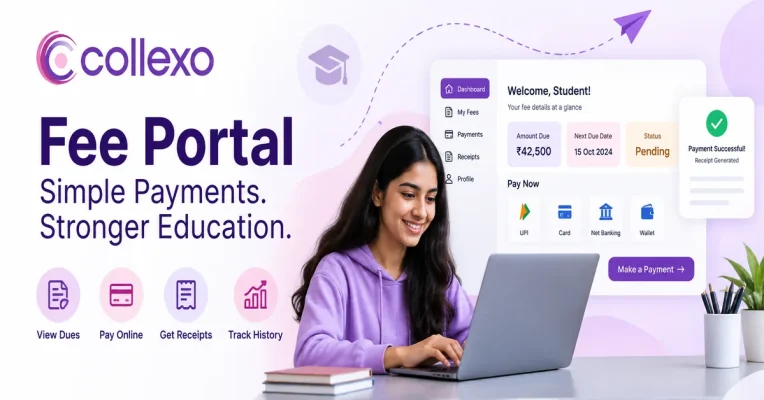
A fee portal should make one of the most important student interactions simple: understanding what is due, paying it and knowing that the payment reached the right place.
Yet many portals stop at the transaction.
A student logs in, enters an amount, chooses a payment method and sees “Payment Successful.”
For the student, that may look complete.
For the institution, however, the transaction still needs context. Which student paid? What fee did the payment settle? Was it a full or partial payment? Did the student receive the correct receipt? Did the payment later reach the institution? What balance remains?
That is why a modern fee portal should not be treated as another payment page.
It should be the student-facing front door to a connected fee system.
When it works well, students get a clearer payment experience while finance teams receive cleaner, more useful payment records.
What is a fee portal?
A fee portal is a digital interface where students or parents can view fee information and complete fee-related actions online.
At its simplest, a portal may let someone log in and pay an amount.
A more useful online fee portal, however, can help a student understand:
What do I owe? → What is this fee for? → When is it due? → How can I pay? → Did the payment succeed? → Where is my receipt? → What do I still owe?
That full journey matters.
A payment page answers only one question:
“How can I pay?”
A proper student payment portal should answer the questions before and after the payment too.
That distinction is important because education fees are not anonymous purchases.
A student may have tuition fees, hostel charges, transport fees, examination fees or other dues. They may also have an instalment plan, scholarship, concession or partial payment.
Therefore, the portal needs education context around the transaction.
A fee portal is not the same as a payment gateway
These terms often get used as though they mean the same thing.
They do not.
A payment gateway helps process a digital transaction.
A fee portal should help the student understand and complete the fee journey around that transaction.
For example, the payment gateway may know:
₹25,000 paid through UPI
The institution needs to know:
Student: Riya Sharma
Fee: Semester 2 Tuition
Amount due: ₹40,000
Amount paid: ₹25,000
Remaining: ₹15,000
Transaction: Successful
Receipt: Generated
The payment transaction is only one part of that record.
This is also how Collexo distinguishes online fee collection from using a gateway alone: the gateway processes the transaction, while the education payment layer connects it with the student, fee, receipt and reconciliation workflow.
That is the difference institutions should look for.
Do not evaluate a fee portal only on whether it can collect money. Evaluate how much context survives after the money is collected.
What should a good fee portal let students do?
Students and parents should not need to understand the institution’s finance system.
They simply need the right information at the right moment.
A useful fee portal should therefore remove questions rather than create new ones.
| Capability | What the student should be able to do | Why it matters |
|---|---|---|
| See current dues | Know the amount currently payable | Removes uncertainty before payment |
| Understand the fee | See what the amount relates to | Prevents payment confusion |
| Check due dates | Know when payment needs to happen | Helps families plan |
| View instalments | Understand what is due now vs later | Avoids showing the entire fee as immediately payable |
| See concessions or scholarships | Understand adjustments to the amount | Makes the payable balance clearer |
| Choose a payment method | Pay through the institution’s available channels | Gives families flexibility |
| Make partial payments where allowed | Pay an approved part of the fee | Supports configured fee plans |
| Confirm payment status | Know whether the transaction succeeded | Prevents repeat payments |
| Access receipts | Find proof of past payments | Reduces dependency on the finance office |
| See payment history | Review earlier transactions | Gives students a clear fee record |
| Check the remaining balance | Know what is still outstanding | Makes the next action clear |
Collexo’s current online payment setup supports digital fee collection through methods such as UPI, cards, net banking, wallets and bank transfers, based on the institution’s configuration. It can also support partial payments while keeping the amount paid and remaining balance connected to the same fee record.
The best fee portal journey starts before “Pay Now”
Many institutions judge their payment experience from the checkout screen onwards.
That is too late.
A student may abandon or delay payment before they ever reach the gateway because they cannot understand the amount shown.
For example:
Why is this amount ₹47,500?
Is this the full semester fee or only this instalment?
Has my scholarship been applied?
Did my previous payment update?
Can I pay only the hostel fee today?
If the portal cannot answer those questions, a large “Pay Now” button does not solve the problem.
A stronger journey looks like this:
Student fee portal journey
Login or secure access
↓
Identify the student
↓
Show total due and upcoming dues
↓
Explain the fee heads and payment schedule
↓
Apply relevant concessions or scholarships
↓
Let the student select what they can pay
↓
Choose a payment method
↓
Complete the transaction
↓
Confirm payment immediately
↓
Generate or show the receipt
↓
Update payment history and remaining dues
The payment itself may take only a minute.
However, the quality of the fee portal depends on everything surrounding that minute.
The student should never have to calculate the payable amount themselves
This sounds obvious, but it is an important design principle.
Suppose a student has:
Tuition fee: ₹80,000
Hostel fee: ₹30,000
Scholarship: ₹20,000
Previous payment: ₹50,000
The student should not need to open several statements and calculate what remains.
The portal should make the current fee position clear.
This becomes even more important when institutions allow instalments, concessions, penalties or partial payments.
A good online fee portal does not merely display finance data.
It turns finance data into an understandable next action.
That is an important distinction.
Finance teams may think in terms of fee heads, ledger entries, demands and adjustments.
Parents think:
“How much do I need to pay today?”
The portal needs to translate between those two views.
A fee payment login should not be the experience
Searches such as “fee payment login” tell us something useful about user behaviour.
Often, students are not searching for an institution’s entire finance system.
They simply want to get back to the place where they can pay.
That makes the login journey part of the payment experience.
A student who receives a fee reminder should not have to:
find the institution website → search for the fee section → locate a portal link → remember a separate username → reset a password → locate the payment page → find the right fee.
Every extra step increases friction before the actual payment begins.
Therefore, institutions should evaluate how students reach the portal as carefully as what happens after they arrive.
Links from relevant messages, websites, student systems or apps should take users into a clear payment journey while still maintaining appropriate security.
A fee portal should remember the student context
Generic checkout pages usually begin with the transaction.
Education payment journeys should begin with the student.
That means the student payment portal should know enough context to show the right financial information.
For example:
Student: Aarav Mehta
Programme: B.Tech Computer Science
Semester: 3
Amount due now: ₹42,500
Next due date: 15 October
Previous payment: ₹35,000
Status: Paid
Current action: Pay Semester 3 balance
Now the portal is not asking the parent to recreate information the institution already has.
Instead, it is helping them act on that information.
This is also why Collexo’s online payment positioning focuses on keeping payments connected to the relevant student and fee record rather than treating them as standalone transactions.
Payment success should update more than the screen
Imagine this situation.
A parent pays ₹40,000 through the fee portal.
The screen says:
Payment Successful
However, the institution’s student record still shows ₹40,000 outstanding.
The parent refreshes.
Nothing changes.
They call the accounts office.
Finance then checks the gateway and confirms that the money was received.
Technically, the payment system worked.
From the parent’s perspective, it did not.
That is because payment success and payment confidence are different things.
A successful portal journey should close the information loop.
After payment, the student should be able to see that the transaction has affected their fee position.
The institution, meanwhile, should receive the corresponding transaction against the correct student record.
That connection reduces the need for both sides to verify the same payment manually.
The receipt is part of the portal journey, not an afterthought
A student often needs proof of payment immediately.
Therefore, the receipt should not require a separate request to the finance office.
A useful fee portal can make current and previous receipts accessible from the same student payment history.
Collexo’s student and parent experience is designed around this self-service model, allowing families to view dues, pay fees and access receipts; the wider Collexo App experience also includes payment and reward features.
That matters for the institution too.
Every time a student can retrieve the right receipt independently, the finance team avoids another routine service request.
This is a broader principle worth applying throughout the portal:
If the student only needs information the system already knows, self-service should be the default wherever appropriate.
The fee portal and finance system should not tell different stories
The student sees the front end.
Finance sees the operational side.
Those two views should remain connected.
Consider one payment:
Student portal
Semester fee due: ₹50,000
Paid: ₹30,000
Remaining: ₹20,000
Finance view
Fee demand: ₹50,000
Transaction: ₹30,000
Receipt: CLX24821
Settlement: Pending
Student balance: ₹20,000
The information shown is different because the users need different levels of detail.
However, the numbers come from the same financial event.
This leads to one of the most important principles for a modern fee portal:
Different users can have different views. They should not have different versions of the truth.
What happens behind the portal matters just as much
Students judge the portal by how easy it is to pay.
Finance teams should judge it by what happens after payment.
For every transaction, ask:
Does it connect to the right student?
Does it reduce the outstanding fee correctly?
Can finance identify the payment mode and transaction reference?
Does the receipt stay connected?
Can the institution later connect the transaction with settlement information?
If the payment gets refunded or reversed, does the history remain clear?
A portal that creates another spreadsheet for finance to reconcile is only moving manual work from the student side to the institution side.
That is not digital transformation.
It is digital collection followed by manual finance.
Why the fee portal matters more as digital payments grow
Digital payment behaviour in India continues to deepen. RBI’s Digital Payments Index increased from a base of 100 in March 2018 to 465.33 by September 2024, driven by growth in payment infrastructure and payment performance.
For education institutions, greater digital-payment adoption creates an opportunity to make fee collection more convenient.
However, it also raises the standard students bring to payment experiences.
People who can complete everyday digital transactions in seconds are unlikely to appreciate unclear fee balances, difficult logins or receipts that require an email to finance.
Therefore, institutions should not view the online fee portal as a technical utility.
It is part of the student and parent experience.
Security should be invisible to the student, not absent
Ease of payment should not come at the cost of financial security.
At the same time, a secure portal does not need to feel difficult to use.
Institutions should evaluate how a provider handles authentication, payment data, permissions, monitoring, backups and security controls rather than assuming that a login screen alone makes a portal secure.
RBI’s 2024 Master Directions for non-bank Payment System Operators emphasise cyber resilience and digital payment security controls as core parts of operating payment systems.
Of course, the exact regulatory responsibilities depend on the parties involved in the payment flow.
Still, the principle for institutions is straightforward:
Security should be built into the payment journey rather than added as friction around it.
RBI Master Directions on Digital Payment Security Controls
A practical fee portal capability checklist
When institutions compare portals, the demo often focuses heavily on the payment screen.
Use a wider test.
| Ask this | What a strong answer should show |
|---|---|
| Can students clearly see what they owe? | Current dues with enough fee context to understand the amount |
| Can they see what comes later? | Upcoming dues or instalment schedules where relevant |
| Can families choose from suitable payment options? | Payment methods configured for the institution |
| Can the portal handle partial payments where allowed? | Paid and remaining amounts stay correctly connected |
| Does the payment update the student’s fee position? | The current balance changes without manual re-entry |
| Can students access receipts themselves? | Current and historic receipts remain easy to retrieve |
| Can they view payment history? | Previous payments appear against the student |
| Does finance receive the student context? | Transactions connect to the relevant student and fee |
| Can the institution follow payments after success? | Records support downstream settlement and reconciliation |
| Can it connect with existing institutional systems? | Supported ERP, SIS, CRM or other system integration |
| Is mobile use practical? | The journey works clearly on the devices families actually use |
| Are security controls appropriate? | Authentication and payment controls match the sensitivity of the data |
Collexo’s online payment capabilities can work with institutional websites and student payment journeys and support connections with ERP, SIS, CRM, enrolment and other systems through supported integrations.
Do not choose a portal based only on how the checkout looks
A polished payment page is useful.
However, it is one of the easiest parts of a product demo to understand.
The harder questions appear after the transaction.
What happens when the student pays only part of a fee?
What happens when a payment succeeds but settlement is delayed?
What happens when the payer tries again after a failed transaction?
What happens when finance needs to refund the payment?
What happens when the student has fees across multiple categories?
What happens when the institution changes a fee or approves a concession?
Those edge cases reveal whether you are buying a fee portal or simply placing a payment form in front of a gateway.
The best portal reduces work on both sides
Student convenience and finance efficiency are sometimes treated as separate goals.
They should reinforce each other.
When the student can see accurate dues, finance receives fewer balance queries.
When the student can retrieve receipts, the accounts office receives fewer receipt requests.
When the payment connects to the correct fee automatically, the finance team does less manual mapping.
When the remaining balance updates after payment, both sides work from the same information.
As a result, the best fee portal does not simply make payments faster.
It removes unnecessary work around the payment.
That is a better standard for institutions to use.
A portal should fit into the complete fee lifecycle
The student sees only part of the fee process.
Behind that experience, institutions still need to manage:
Fee setup → Fee communication → Payment → Receipt → Settlement → Reconciliation → Refund or adjustment → Reporting
A student-facing portal should connect naturally to that larger lifecycle.
Otherwise, the institution may create an excellent checkout experience while leaving finance teams with fragmented operations behind it.
Collexo’s current approach brings fee setup, collections, follow-ups, reconciliation and visibility into one connected system rather than treating student payments as an isolated workflow.
That is the direction institutions should evaluate:
A simple front end for families, connected to a complete financial process behind it.
What should a modern fee portal really achieve?
A modern fee portal should make three things easier.
For the student or parent:
Understand. Pay. Confirm.
For finance:
Identify. Record. Reconcile.
For the institution:
Collect with less friction and maintain clearer financial records.
If a portal only solves the middle step, Pay, it leaves too much work around the transaction.
That is why institutions should move beyond asking:
“Can students pay online?”
A better question is:
“Can students complete the entire fee interaction without confusion, and can finance trust what happens afterwards?”
If the answer is yes, the portal is doing more than digitising payment.
It is improving the fee experience.
Improve the payment experience
Collexo helps education institutions collect fees online while keeping each payment connected to the relevant student, fee and transaction record. Students and parents can get a simpler way to view dues, pay fees and access receipts, while finance teams keep the payment connected to the wider fee lifecycle.
Explore Collexo Online Payments
Frequently asked questions
What is a fee portal?
A fee portal is an online interface where students or parents can view fee information and complete fee-related actions. A good portal can show current dues, payment details, payment history and receipts while connecting each transaction to the institution’s fee records.
What is an online fee portal?
An online fee portal allows students or parents to access fee information and make payments digitally. Depending on the platform, it can support different payment methods, instalments, receipts and student payment history.
What is the difference between a fee portal and a payment gateway?
A payment gateway processes the financial transaction. A fee portal adds the student and fee context around it, such as the amount due, fee head, payment history, receipt and remaining balance.
What should students see in a fee portal?
Students should be able to understand what they owe, what the amount relates to, when it is due and how they can pay. After payment, they should also be able to confirm the transaction, find the receipt and see the updated fee position.
Should a fee portal allow partial payments?
Institutions may allow partial payments where their fee policies and system configuration support them. In that case, the portal should clearly show the amount paid and the remaining balance rather than treating each payment as an unrelated transaction.
Can a fee portal connect with an ERP or student information system?
Yes, depending on the product and supported integrations. For example, Collexo can support online fee collection through institutional websites and student payment journeys and connect with ERP, SIS, CRM, enrolment and other systems through supported integrations.
Is a fee payment login enough for online fee collection?
No. Login is only the access point. The quality of the experience depends on what happens afterwards: whether students can understand dues, pay easily, confirm payment, retrieve receipts and see the correct balance.
How does a fee portal help finance teams?
A connected portal can reduce routine student queries while giving finance cleaner payment records. The strongest systems also connect payments to students, fee demands, receipts and downstream reconciliation rather than leaving finance to match transactions manually.