
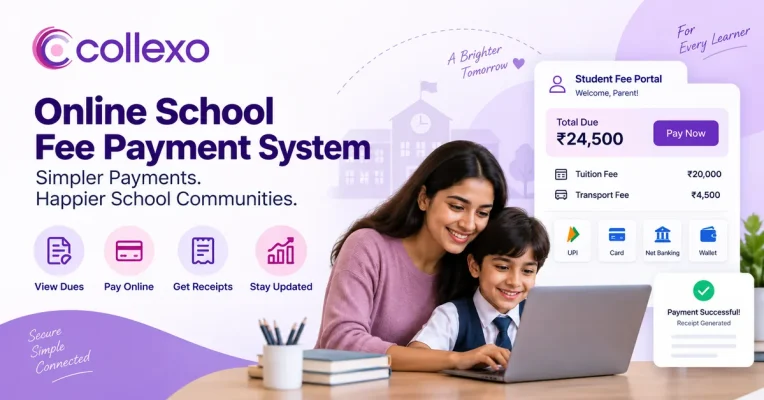
An online school fee payment system should do more than let parents transfer money to a school.
It should make the entire payment journey easier to understand, from seeing what is due to receiving a receipt. At the same time, the school should know who paid, what the payment was for, what remains outstanding and whether the money later settled correctly.
That distinction matters.
A payment can succeed online while the finance team still spends time identifying the student, updating a fee ledger, sending a receipt or matching the transaction with a settlement report.
In that case, the school has digitised the payment.
It has not digitised the fee collection process.
A good online school fee payment system connects both sides of the journey: a simple experience for parents and a reliable financial record for the institution.
What is an online school fee payment system?
An online school fee payment system is a digital system that allows schools to collect student fees online while keeping each transaction connected to the relevant student and fee.
Depending on the school’s setup, parents may use it to pay tuition fees, term fees, transport charges, activity fees and other configured school dues. Collexo supports these school fee payment journeys while keeping the payment connected to the corresponding student and fee record.
A complete system usually covers much more than checkout.
It should help answer:
What does the student owe?
What is due now?
Which fee is being paid?
Which payment method can the parent use?
Did the transaction succeed?
Was a receipt created?
What balance remains?
Did the institution eventually receive and reconcile the payment?
This is why a school fee payment system should not be evaluated only by the quality of its payment screen.
The financial process before and after that screen matters just as much.
Online school fee payment is not the same as adding a payment gateway
A payment gateway performs an important job: it processes the financial transaction.
However, schools need more context around that transaction.
Suppose a gateway reports:
₹28,500 paid successfully
Finance still needs to know:
Student: Aarav Sharma
Class: VIII
Term: Term 2
Tuition fee: ₹25,000
Transport fee: ₹3,500
Total paid: ₹28,500
Payment status: Successful
Receipt: Generated
Balance: ₹0
The first record confirms that money moved.
The second explains whose money it was and what it settled.
That is the difference between adding an online payment option and building a connected school online fee payment process.
Collexo’s Online Payments product follows this model by keeping digital transactions linked with student and fee records rather than treating each payment as an isolated transaction.
Explore Collexo Online Payments
How should an online school fee payment system work?
The ideal process starts before a parent clicks Pay Now.
1. Create the correct fee
First, the school defines what each student needs to pay.
That can include tuition, term, transport, activity or other applicable fees. The school may also need to account for payment schedules, concessions, scholarships or other adjustments.
This creates the financial context for the transaction.
2. Show the parent what is due
Next, the parent should see an understandable fee position.
Instead of displaying only a total such as ₹48,500, the system should make it clear what that amount represents and when it needs to be paid.
For example:
Tuition fee: ₹40,000
Transport: ₹8,500
Amount due now: ₹48,500
Due date: 15 October
Clear information reduces uncertainty before payment begins.
3. Let the parent choose an available payment mode
Once the amount is clear, the parent chooses from the payment options that the school has enabled.
Collexo’s current online payment setup supports journeys through UPI, credit and debit cards, net banking, digital wallets and bank transfers, depending on the institution’s configuration.
4. Process the transaction
The selected payment provider then handles the actual financial transaction.
At this point, the parent’s main concern is simple:
Did my payment go through?
The result should therefore be clear. If the payment succeeds, show success. If it fails, the user should not be left guessing whether to pay again.
5. Confirm the payment and create the receipt
Once the transaction succeeds, the payment should return to the correct student record.
The system can then generate the corresponding payment receipt. Collexo supports receipt generation against successful transactions while keeping that receipt connected to the payment record.
6. Update the student’s fee position
If ₹48,500 was outstanding and the parent paid ₹48,500, the student’s financial position should reflect that payment.
Likewise, if the school allows a partial payment, the amount paid and remaining balance should stay connected to the same fee record. Collexo supports partial-payment journeys where institutions have enabled them in their fee setup.
7. Follow the payment through settlement and reconciliation
Finally, finance needs to know what happened after the parent paid.
Did the transaction settle?
What amount reached the institution?
Does it match the payment record?
Are there any exceptions?
That is where an online school fee payment system becomes part of the wider finance workflow rather than ending at the checkout screen.
Which online payment modes should schools consider?
There is no single payment mode that every family will prefer.
Therefore, schools should focus on offering suitable options while keeping all resulting transactions connected to the same student fee record.
| Payment mode | Why families may use it | What schools should consider |
|---|---|---|
| UPI | Fast mobile payments through familiar apps | Clear transaction confirmation and student mapping |
| Credit cards | Useful for larger payments and card preference | Transaction status, charges and settlement visibility |
| Debit cards | Direct payment from the payer’s account | Reliable payment confirmation |
| Net banking | Familiar option for bank-based payments | Clear return to the school payment journey |
| Digital wallets | Convenient for users who prefer wallet payments | Consistent payment records |
| Bank transfer | Useful where direct transfer forms part of the setup | Correct identification and mapping of the payment |
UPI deserves particular attention in India simply because of how deeply it has entered everyday payment behaviour. NPCI reported 24.5 billion UPI transactions in August 2026 alone, with transaction value of about ₹29.82 trillion.
UPI also supports instant bank-to-bank payments and is available around the clock, which helps explain why it has become such a common consumer payment behaviour.
However, the lesson for schools is not “offer as many methods as possible.”
The better principle is:
Offer relevant ways to pay, but keep every payment connected to one fee record.
A good payment experience begins before checkout
Schools sometimes focus on reducing the number of clicks inside the payment gateway.
That helps.
However, payment friction can start much earlier.
A parent may first need answers to questions such as:
Why is this amount due?
Is this tuition only, or does it include transport?
Has my concession been applied?
Did my previous instalment update?
Can I pay part of the amount now?
When is the next instalment due?
If the system cannot answer these questions clearly, a fast payment gateway will not fix the experience.
Therefore, the online school fee payment system should help the parent understand the financial position before asking them to pay.
The payment button should be the next obvious step, not the first piece of information they see.
What parents should see before they pay
A useful parent-facing payment journey does not need to look like an accounting system.
In fact, it should do the opposite.
Finance may need detailed fee heads, schedules, transaction references and settlement information.
Parents need a much simpler view:
Student
Riya Sharma
Class VII
Due now
₹35,000
Includes
Term Fee ₹30,000
Transport ₹5,000
Due date
20 October
Next step
Pay ₹35,000
This is an important design principle for any digital fee payment journey.
Show people the information they need to act, not every field the finance team needs to manage.
The underlying information can remain detailed without making the parent’s experience complicated.
An institutional example: follow one school fee payment
Consider a fictional school, Greenfield Academy.
The school has 2,000 students and collects tuition, transport and activity fees.
For one Grade VIII student, the next payment looks like this:
Tuition: ₹30,000
Transport: ₹4,500
Activity fee: ₹2,000
Total due: ₹36,500
Previously, the school sent parents a payment link. Once payments arrived, finance downloaded transaction reports and compared them with student records.
Most payments worked.
However, the difficult part came afterwards.
One parent paid only ₹30,000.
Another paid twice after the first confirmation page failed to load.
A third sent a payment but entered a different reference.
Finance then needed to investigate what each payment meant.
Now imagine the same journey through a connected online school fee payment system.
The parent opens the student’s fee account and sees ₹36,500 due.
Because the school allows partial payment, the first family pays ₹30,000. The student’s record now shows ₹30,000 paid and ₹6,500 remaining.
The second parent’s successful transaction updates the student account, so they can see that the payment has already gone through before trying again.
Meanwhile, finance sees each transaction against the correct student and fee.
Later, the team follows those payments into settlement and reconciliation.
The improvement is not merely that parents paid online in both cases.
The difference is how much work remains after they pay.
Payment success should update the school record
This is one of the most important tests of any school payment system.
Imagine a parent completes a ₹25,000 payment.
Their screen shows:
Payment Successful
Yet the school portal still shows:
₹25,000 outstanding
What happens next?
The parent refreshes.
Then they check their bank account.
Eventually, they call the school.
Finance checks the gateway, finds the payment and assures the parent that the money was received.
Technically, the digital transaction succeeded.
The overall experience failed.
A strong online school fee payment system should close this information loop.
The payment should connect back to the right student and update the relevant financial record.
As a result, the parent receives confidence while the finance team avoids another manual verification request.
Partial payments need context too
Schools may sometimes allow families to pay fees in instalments or make partial payments.
In that situation, the payment record needs to preserve three different amounts:
Amount due
Amount paid
Amount remaining
For example:
Fee due: ₹50,000
Paid today: ₹20,000
Remaining: ₹30,000
The parent should understand this immediately.
At the same time, finance should not receive a standalone ₹20,000 transaction with no connection to the original ₹50,000 fee.
Instead, both amounts should remain part of the same financial history.
Collexo can support partial fee payments where the institution has configured them, while keeping the collected and remaining amounts connected to the relevant fee record.
Receipts should follow the payment automatically
A successful school online fee payment should not create another task for the parent.
If the system already knows who paid, what they paid and whether the transaction succeeded, the receipt should remain connected to that same payment.
Parents can then retrieve it when needed instead of asking the accounts team to locate and resend it.
This creates a small but important efficiency gain.
One parent requesting a receipt is not a major problem.
Hundreds of parents asking for old receipts, payment confirmations and fee histories creates recurring work for the finance office.
Therefore, self-service should extend beyond payment itself.
Paying online should also make the payment easier to prove later.
Online collection should not create offline reconciliation
This is where many fee payment systems fall short.
The parent experience becomes digital.
The finance process stays manual.
Money arrives through different payment modes. Finance downloads gateway reports. Someone exports student fee data. Another person compares the bank statement. Then the team starts matching the records.
At that point, technology has moved the collection online but has not removed the work around it.
That is why institutions should evaluate what happens after the transaction.
A connected reconciliation process should help finance connect payment information with the corresponding fee and settlement record.
Explore Collexo Fee Payment Reconciliation
The real goal is not simply:
Payment collected
It is:
Payment collected → identified → recorded → settled → reconciled
What should schools look for in an online school fee payment system?
A product demo can make almost any payment screen look straightforward.
Therefore, schools need a wider capability checklist.
Clear student-level dues
The system should show the correct fee against the correct student.
Parents should understand both the amount and what it relates to.
Flexible fee structures
Schools may need to manage tuition, transport, activity and other fee types.
In addition, different students may have different schedules or adjustments.
The online payment journey should reflect that underlying fee setup accurately.
Explore Collexo Fee Management
Suitable payment methods
Parents should have practical payment options based on the institution’s configured setup.
However, every mode should still return to the same student financial record.
Partial-payment support where needed
If the school allows partial payment, the system should show what the family paid and what remains.
Immediate payment status
Parents should not need to guess whether a transaction succeeded.
Clear payment confirmation also helps reduce accidental repeat payments.
Connected receipts
The receipt should connect with the successful transaction and remain easy to retrieve.
Student payment history
Families should be able to understand what they have already paid.
Likewise, the finance team should be able to trace the same history from its own operational view.
Settlement visibility
The school needs visibility beyond the payer’s transaction.
Finance should also understand when and how collected amounts reach the institution.
Reconciliation
The system should help connect fee records, payments and downstream settlement information instead of relying entirely on manual matching.
Integrations
Schools may already use ERP, SIS, CRM, admissions or other institutional systems.
Therefore, evaluate whether the payment system can connect with the wider technology setup.
Collexo’s online payments capability can support integration with ERP, SIS, CRM, enrolment and other institutional systems through supported integrations.
Do not judge the system only by the happy path
A demo usually shows the easiest transaction:
Parent opens payment page.
Parent chooses UPI.
Payment succeeds.
Receipt appears.
Done.
Real finance operations contain more variation.
Therefore, ask vendors to demonstrate what happens when:
- a payment fails,
- a parent tries again,
- only part of a fee gets paid,
- the student has multiple fee heads,
- a concession changes the payable amount,
- a payment needs a refund,
- settlement does not match expectations,
- finance cannot immediately identify a transaction, or
- the school needs to trace an old payment.
The answer to those questions tells you far more about the system than the Pay Now screen.
A reliable online school fee payment system needs to handle the messy parts of payment too.
Security belongs in the buying decision
Schools handle student information alongside financial transactions, so security cannot become an afterthought.
However, schools also need to distinguish between their own role and the obligations that apply to banks, payment systems and payment service providers.
For example, RBI’s Master Directions on cyber resilience and digital-payment security apply to authorised non-bank Payment System Operators. They include requirements around areas such as cyber controls, transaction notifications and security practices.
RBI Master Directions on Digital Payment Security
A school does not become a Payment System Operator simply because it accepts online fees.
Still, the regulatory focus shows why institutions should ask potential providers practical security questions:
Who handles sensitive payment information?
How does authentication work?
What transaction information does the school store?
Who can access student payment records?
How are permissions controlled?
How does the provider manage security incidents and backups?
The right buying decision therefore looks beyond convenience.
A payment journey should be easy for parents without becoming careless with financial data.
What online fee collection should change for finance teams
The value of digital fee payment should eventually show up in finance operations.
If parents pay online but staff still manually update student balances, the institution has only digitised part of the process.
A more connected approach can reduce several types of repetitive work.
Instead of manually identifying payments, the system keeps the student context attached.
Rather than generating receipts separately, successful transactions remain linked with receipts.
When a partial payment occurs, the balance stays connected to the original fee.
Finally, reconciliation connects the parent transaction to what finance needs to verify later.
This is the difference between digitising a payment method and digitising a fee workflow.
Three experiences need to work together
Schools often evaluate payment software primarily from one perspective.
Usually, that is the parent.
Parent experience is important, but an effective system serves three groups.
Parents need clarity
They want to know:
How much is due?
Why?
When?
How can I pay?
Did it work?
Where is my receipt?
Finance needs control
The finance team needs:
the correct student record, fee context, payment reference, outstanding amount, settlement information and reconciliation.
Leadership needs visibility
School leaders need a higher-level view:
What has been collected?
What remains due?
Where are the gaps?
These experiences should not require three separate versions of the underlying information.
The online school fee payment system should connect them.
The strongest payment systems reduce questions, not just clicks
Speed matters.
However, measuring only how quickly a parent can reach the payment gateway misses much of the opportunity.
A better system should reduce questions such as:
“How much do I owe?”
“Did my payment go through?”
“Why is this still showing as due?”
“Can you send me my receipt?”
“How much is left?”
At the same time, it should reduce finance questions such as:
“Who made this transaction?”
“Which fee should we adjust?”
“Has this payment settled?”
“Why does the bank amount differ?”
When both sides ask fewer questions, the payment process is actually improving.
That is a better outcome than merely moving the payment screen online.
What should a modern online school fee payment system achieve?
A modern online school fee payment system should make the financial journey simpler without removing the context finance needs.
For parents:
Understand the due → Choose how to pay → Pay → Confirm → Retrieve the receipt
For finance:
Create the fee → Identify the payment → Update the student record → Track settlement → Reconcile
Those are not two separate processes.
They are two sides of the same transaction.
The best system connects them.
Therefore, schools evaluating online payments should move beyond:
“Can parents pay fees online?”
Instead, ask:
“What happens to the payment before, during and after the transaction?”
That question reveals whether you are buying a payment button or building a better fee collection process.
Explore online fee collection
Collexo helps schools collect configured tuition, term, transport, activity and other student fees online while keeping payments connected with the relevant student and fee records. It supports payment journeys through UPI, cards, net banking, digital wallets and bank transfers based on the institution’s configured setup.
Explore Collexo Online Payments
Frequently asked questions
What is an online school fee payment system?
An online school fee payment system lets schools collect student fees digitally while keeping the payment connected to the relevant student and fee. A complete system can also support payment confirmation, receipts, outstanding balances and downstream finance processes.
How does online school fee payment work?
The school first creates the fee due for the student. The parent then views the amount, selects an available payment method and completes the transaction. Afterwards, the system should confirm the payment, update the student fee record and create or provide the relevant receipt.
Which payment modes can schools offer online?
Depending on the provider and the school’s setup, payment options can include UPI, credit cards, debit cards, net banking, digital wallets and bank transfers. Collexo supports these online payment journeys based on each institution’s configured payment setup.
Can parents make partial school fee payments online?
Yes, if the institution’s fee policy and payment system support partial payments. The system should then keep both the amount paid and the remaining balance connected to the same fee record.
What is the difference between a payment gateway and a school fee payment system?
A payment gateway mainly processes the transaction. A school fee payment system adds education context by connecting that transaction with the student, fee, receipt, outstanding balance and wider finance process.
Does an online school fee payment system generate receipts?
A system can generate or provide a receipt after a successful transaction. For example, Collexo can generate payment receipts and keep them connected with the corresponding transaction record.
Can online school fee payment systems connect with ERP or SIS software?
It depends on the platform. Collexo can support connections with ERP, SIS, CRM, enrolment and other institutional systems through supported integrations.
Why is reconciliation important for online school fee payments?
Payment success confirms that the payer completed the transaction. Finance still needs to connect that transaction with the student record and downstream settlement information. Reconciliation helps the institution verify that the financial journey closes correctly.
Is UPI useful for school fee payments?
UPI is widely used for digital payments in India and supports instant bank-to-bank payments. NPCI reported 24.5 billion UPI transactions during August 2026, which shows the scale of current usage.
What should a school check before choosing a fee payment system?
Schools should review fee setup, payment methods, student-level mapping, payment confirmation, partial-payment support, receipts, settlement visibility, reconciliation, integrations and security. Most importantly, they should test what happens when a transaction does not follow the ideal payment path.