
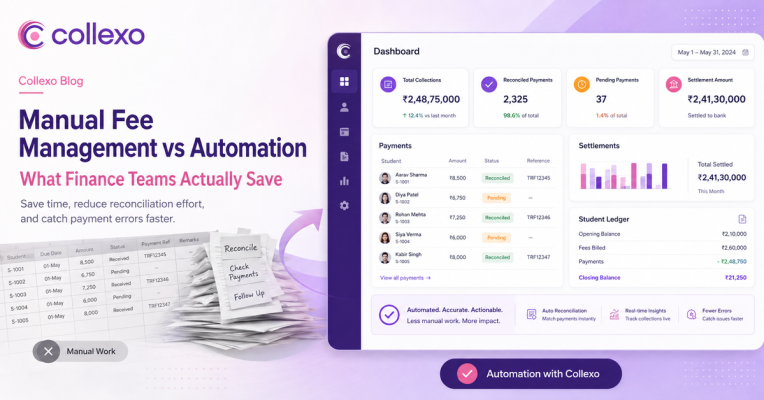
Finance teams at schools, colleges, and EdTech platforms know the drill. Fee collection season arrives, and spreadsheets multiply. Automated fee management exists to solve exactly this problem, matching every payment to the right student without hours of manual work. The real question is how much time and accuracy it actually returns.
Automated fee management uses software to configure fee structures, collect payments across channels, and match every transaction to the right student record without manual entry. Instead of staff cross-checking bank statements against fee registers line by line, the system does the matching and flags only what needs a human look. This means fewer hours on repetitive work and fewer errors reaching the books.
Where manual fee management breaks down
Manual fee management usually starts simple. A spreadsheet tracks who owes what. As institutions grow, though, the cracks show fast. Fee heads multiply across programmes and campuses. Payments arrive through UPI, bank transfer, cheque, and cash, often on the same day.
Someone still has to reconcile every one of them against the right invoice. This is where finance teams lose the most time. A single suspense entry, a payment that cannot be traced to a student, can take an accountant an hour or more to resolve. Multiply that across hundreds of payments a week, and reconciliation alone eats a real share of the month.
Time saved: a before and after comparison
Consider a mid-sized university processing 5,000 fee payments a month across three campuses. Under a manual process, finance staff typically spend two to three working days each month just matching gateway settlements to student ledgers. Add reminder calls for overdue fees, and several more days disappear into follow-up work a system could trigger on its own.
With automated fee and settlement reconciliation, that same institution can expect most payments matched within hours instead of days. As a result, staff time shifts away from manual matching and toward reviewing the small number of flagged exceptions. In practice, this can cut reconciliation workload by more than half, freeing finance teams to focus on forecasting rather than transaction chasing.
Errors and revenue leakage: what automation catches
Manual processes do not just cost time. They cost accuracy. A missed instalment, a duplicate payment, or a settlement that never gets matched to the right student can sit unnoticed for months under a manual system. Each of these is a small revenue leak that adds up.
Automated systems classify every transaction by status the moment it happens. Manual reconciliation typically carries a 3 to 5 percent error rate, according to industry benchmarking data, and each one takes time to trace back to its source. Successful payments without matching fee records, refunds not yet reflected in the ledger, and settlement mismatches all surface as exceptions instead of hiding in a spreadsheet. This means finance teams catch discrepancies while they are still cheap to fix, rather than during a stressful year-end audit.
What finance teams should track before and after switching
Before comparing manual and automated fee management, it helps to measure a few concrete numbers. How many hours per week go into reconciliation right now. How many suspense entries typically sit unresolved at month end. How often late fees or scholarships get applied inconsistently across campuses.
These figures give finance teams a real baseline. Once automation is in place, the same metrics show the actual return: hours reclaimed, exceptions resolved faster, and fewer manual overrides needed at closing time. This is what turns automation from a vague productivity claim into a number a CFO can act on.
How Collexo brings manual and automated fee management together
Collexo runs fee management, collection, and reconciliation as one connected workflow rather than three separate systems finance teams have to bridge manually. Fee structures, instalments, scholarships, and late fees are configured once and applied consistently across every programme and campus. Payments collected through UPI, cards, net banking, Collexo AutoDebit, QR, and offline channels all feed into the same student ledger automatically.
Because reconciliation happens continuously rather than at month end, finance teams see collection status, pending dues, and exceptions in real time instead of reconstructing them from separate reports. One Collexo customer, Mr. Dhruv Joshi, Chief of Operations & Admin, put it simply: manual input in the accounts reduced drastically after switching, with automated receipt generation as an added benefit for the team.
For finance teams still comparing manual effort against automation, the clearest signal is usually the reconciliation backlog itself. If suspense entries pile up every month and staff spend more time matching payments than reviewing them, that is the gap automation is built to close. Talk to Collexo to see what automated fee management would look like against your own current numbers.