
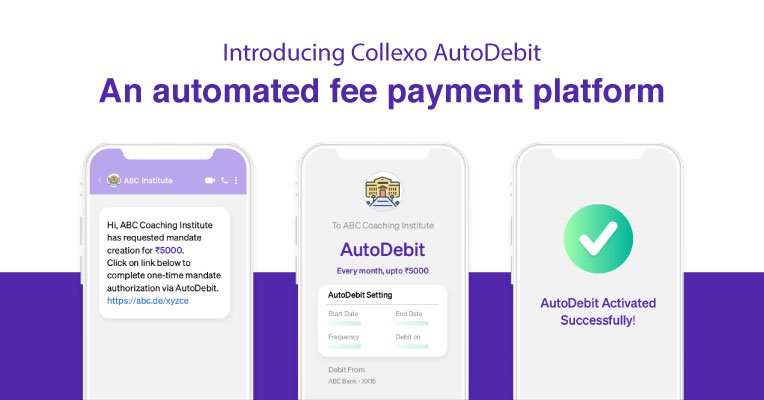
Collexo AutoDebit helps educational institutions collect recurring fees on schedule without making every due date another round of reminders and follow-ups.
Recurring fees are common across education. Schools collect monthly or term-wise tuition. Colleges and universities may use semester instalments. Coaching institutes and EdTech companies may collect programme fees across several payment dates.
However, the collection process often repeats every time.
A fee becomes due. The team sends a reminder. The parent or student makes the payment. Finance checks the transaction. Then the same process starts again for the next instalment.
As the number of students and payment cycles grows, so does the work.
That is why we introduced Collexo AutoDebit.
Instead of creating a new payment request for every eligible instalment, institutions can set up an authorised recurring mandate once and initiate scheduled fee debits according to the configured fee plan. Parents stay informed before and after the debit, while each payment remains connected to the student, fee, receipt, and settlement.
The result is simple:
Recurring fees can run on a schedule instead of depending on recurring manual work.
Why we built Collexo AutoDebit
A recurring fee is predictable.
The work around it often is not.
Consider a school collecting ₹12,000 in tuition every month.
Without an automated collection process, each payment cycle may involve:
Fee due → Reminder → Follow-up → Payment → Status check → Receipt → Reconciliation → Repeat next month
Now multiply that process across hundreds or thousands of students.
Even when most parents pay on time, teams still spend time preparing requests, sending reminders, checking payment status, updating records, and identifying the families who actually need follow-up.
Collexo AutoDebit changes that model.
Once an eligible payer authorises the recurring mandate, future debits can follow the configured fee schedule.
So instead of managing every due date manually, the team can focus on the exceptions that need action.
What is Collexo AutoDebit?
Collexo AutoDebit is a recurring fee collection capability built into Collexo Fee Collection.
It connects the complete recurring payment cycle:
Fee Plan → Mandate → Scheduled Debit → Parent Communication → Payment Status → Student Record → Reconciliation
Institutions can use it for monthly, quarterly, term-wise, or other configured recurring education fee schedules. A single authorised mandate can cover eligible instalments within the approved schedule, while teams can track active, pending, failed, and cancelled mandates from one view.
More importantly, the debit does not sit separately from the rest of the fee journey.
A successful collection can remain connected to the right student, fee head, instalment, receipt, ledger, and settlement.
How does Collexo AutoDebit work?
The idea is to automate the repeatable parts of recurring fee collection while keeping the institution in control.
1. Start with the recurring fee plan
Before a debit can happen, the institution needs to know what should be collected and when.
For example:
Student: Ananya Mehta
Fee: Semester instalment
Amount: ₹20,000
Frequency: Monthly
Due date: 5th of every month
The fee structure, amount, payment frequency, and due dates form the basis of the recurring collection journey.
Institutions can manage these structures, schedules, instalments, and other fee rules through Collexo Fee Management. The current Fee Management layer supports programme and student-level fee structures, billing cycles, due dates, instalments, scholarships, penalties, and related rules.
Once the schedule is clear, AutoDebit can follow it.
2. Authorise the recurring mandate once
The parent or payer approves an eNACH mandate connected to the relevant student and recurring fee plan.
This gives the institution the required authorisation to initiate eligible debits according to the agreed mandate and schedule.
A new mandate is not needed for every covered instalment. Instead, one authorised mandate can support eligible recurring payments that fall within its approved conditions.
eNACH operates within India’s National Automated Clearing House framework. NPCI describes NACH as infrastructure designed for repetitive and periodic electronic transactions.
For more information on the underlying framework, see NPCI’s overview of NACH.
3. Collect eligible fees on the scheduled date
Once the mandate is active, the institution does not need to create a fresh payment request for every eligible instalment.
Collexo can initiate the debit according to the configured fee schedule.
For example:
5 August → ₹20,000 semester fee → Scheduled for debit
The institution can define the amount, frequency, fee heads, and debit dates according to the student’s fee plan. Collexo then records the outcome when the payment is presented for collection.
As a result, recurring collection moves from a team-dependent process to a scheduled workflow.
4. Tell parents what is about to happen
Automation should not mean taking the payer by surprise.
Before an upcoming debit, parents can receive information about the amount and scheduled date.
For example:
Your scheduled fee of ₹20,000 will be debited on 05 August.
After the payment attempt, they can also receive the result.
Payment successful: ₹20,000 collected for MBA Semester Fee.
If another payment is scheduled, the next debit date can also remain visible.
The current AutoDebit workflow connects these advance debit notifications and payment outcome updates with the recurring collection cycle.
That means parents know what is coming, while the institution does not need to send the same manual reminder every month.
5. Know which payments need attention
Automation does not mean every debit will always succeed.
A payment may fail or remain pending.
That is precisely why the institution needs clear status visibility.
Instead of assuming every scheduled debit was successful, teams can see which collections are:
Scheduled · Successful · Pending · Failed
Failed attempts remain visible against the relevant student and mandate, allowing the team to follow up where action is actually needed.
This changes the team’s job.
Instead of chasing every payer before every due date, they can concentrate on the smaller group of exceptions that require follow-up.
6. Keep each AutoDebit payment connected
A successful debit is useful only when the institution knows what it belongs to.
Suppose ₹20,000 is collected automatically.
Finance teams still need to know:
Which student? Which fee? Which instalment? Which receipt? Which settlement?
Collexo connects each successful collection to the relevant student, fee head, instalment, receipt, ledger, and reconciliation record.
The journey can therefore remain:
Student → Fee Plan → Mandate → Debit → Receipt → Ledger → Settlement → Reconciliation
That connection prevents recurring payments from becoming another isolated payment file that finance teams need to map later.
For the wider settlement and matching workflow, institutions can use Collexo Fee Payment Reconciliation.
What does Collexo AutoDebit change for parents?
Recurring education fees often require parents to remember several due dates across the year.
They may need to log in, find the applicable fee, choose a payment mode, and complete the transaction every time.
With an authorised AutoDebit mandate, that repeated payment step can be reduced for eligible fees.
Parents approve the mandate once. Then eligible debits can follow the agreed schedule.
They also remain informed about upcoming collections and payment outcomes.
So the experience becomes more predictable:
Know the amount → Know the date → Debit happens → Receive the result
Importantly, the mandate does not remove visibility or control around the payment schedule. It provides the authorisation under which eligible recurring payments are initiated.
What does Collexo AutoDebit change for institutions?
The value goes beyond automatically moving a payment.
Reduce repeated follow-ups
Recurring fees often create recurring reminder work.
AutoDebit allows eligible collections to follow the fee schedule instead, so teams do not have to start every payment cycle with another manual request.
Collect closer to the configured due date
Because the debit is initiated according to the scheduled fee plan, collection does not depend on the payer remembering to return to the payment page first.
Find failures faster
Not every debit will succeed.
However, failed and pending payments can be surfaced clearly so teams know which students require follow-up rather than checking every payment manually.
Keep finance records connected
Every successful debit can stay linked to the relevant student, fee plan, receipt, and settlement.
As a result, recurring collection and reconciliation do not need to become separate processes.
Manual recurring collection vs Collexo AutoDebit
The difference is not simply whether a payment happens automatically. It is how much of the recurring workflow stays connected.
| Collection need | Manual recurring collection | AutoDebit workflow |
|---|---|---|
| New payment request for each instalment | Usually required | One authorised mandate for eligible payments |
| Collection initiated on due date | Depends on team and payer action | Scheduled according to fee plan |
| Parent communication | Repeated manual effort | Connected pre-debit and outcome communication |
| Payment status | Checked across payment records | Scheduled, successful, pending and failed status visible |
| Mapping to student and fee | May require later matching | Connected to student and fee record |
| Team focus | Every payment cycle | Exceptions that need attention |
So AutoDebit is not simply a replacement for reminders.
It changes recurring fee collection from managing every due date to managing the schedule and its exceptions.
Where can Collexo AutoDebit be useful?
Recurring fee models look different across education, but the underlying problem is similar.
For schools, AutoDebit can support monthly or term-wise tuition, transport, daycare, activity, and other scheduled fees.
In higher education, institutions can use recurring mandates for eligible semester instalments, hostel, mess, transport, and programme fee cycles.
For coaching and training institutes, it can support recurring tuition or longer programme payment plans.
Meanwhile, EdTech businesses can use scheduled collection for eligible programme instalments and recurring learning payments.
Multi-campus organisations can also use a consistent recurring collection workflow while keeping each payment tied to the correct student and fee record. These are all use cases currently supported in Collexo’s AutoDebit positioning.
Collexo AutoDebit is one part of a wider fee collection journey
Not every fee should be collected through AutoDebit.
An application fee may be easier to pay through online checkout.
An overdue payment may need a direct payment link.
A high-value fee may be better suited to EMI.
A payment at the campus counter may use Dynamic QR.
Recurring tuition or instalments, however, may be a natural fit for AutoDebit.
That is why AutoDebit sits inside Collexo Fee Collection rather than operating as a disconnected recurring-payment platform. Collexo brings online checkout, payment links, AutoDebit, EMI, Dynamic QR, offline payments, and international collections into one fee collection layer.
The payment route can change.
The student and fee context should stay connected.
Recurring fees without recurring manual work
A recurring fee should not require teams to rebuild the collection process every month, quarter, or term.
Collexo AutoDebit turns the repeatable parts of fee collection into a scheduled workflow.
The payer authorises a mandate once. Eligible fees follow the configured schedule. Parents know when the debit is coming. Payment outcomes remain visible. Failed collections surface for follow-up. Successful payments stay connected to the student, fee, receipt, settlement, and reconciliation record.
So instead of spending time managing every recurring due date, teams can spend more time on the cases that actually need their attention.
And because AutoDebit is part of Collexo Fee Collection, recurring payments remain connected to the same fee journey as every other way students and parents pay.
One operating system for every fee collection and management.
Want to see the complete recurring collection journey? Explore how scheduled fee collection works.