
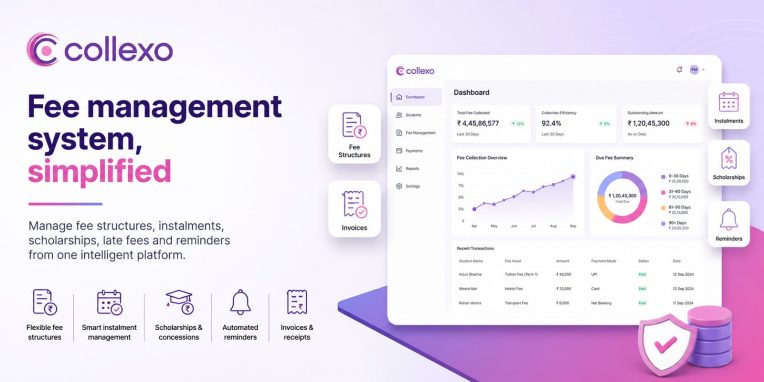
A fee management system brings every fee rule an institution runs into one place. It handles fee structures, instalments, scholarships, late fees, and reminders instead of leaving each task to a spreadsheet or a separate tool. This matters because fee operations touch finance, admissions, and student experience teams at the same time, and a disconnected setup slows all three down.
Most institutions did not choose their current fee process. It grew, one exception at a time, until spreadsheets, manual invoices, and ad hoc discount approvals became the default. A proper fee management system replaces that patchwork with a single system of record.
What is a fee management system?
A fee management system is software that lets institutions configure, assign, invoice, and track student fees from one dashboard. It covers fee structures, payment schedules, due dates, scholarships, concessions, penalties, taxes, and receipts. In practice, it becomes the reference point for what a student owes, what they have paid, and what remains outstanding.
This differs from a payment gateway, which only processes a transaction. A fee management system governs the rules behind that transaction: who owes what, under which plan, with which discount applied, and by when.
Core features to expect from automated fee management
A capable fee management system starts with a fee structure builder. This lets finance teams define fee heads, billing cycles, and due dates by programme, campus, or student cohort, so a hostel fee and a tuition fee never share the same rulebook by accident.
Instalment management comes next. Large fees get broken into term-wise, monthly, or custom payment plans, with partial payments and outstanding balances tracked against each learner individually. This is where automated fee management saves the most manual effort, since a team no longer has to reconcile fifteen instalment dates by hand.
Scholarships and concessions need rule-based logic rather than manual overrides. A fee management system should apply merit scholarships, sibling discounts, or need-based waivers automatically, with an approval workflow behind each adjustment so finance retains control. Late fees follow the same pattern: grace periods, flat or percentage penalties, and waiver rules get defined once and applied consistently after that.
GST and tax configuration matter more than most buyers expect. Fee heads carry different tax treatments, and a system that handles SGST, CGST, and IGST correctly avoids a recurring compliance headache. Invoices and receipts should generate automatically once a payment is recorded, branded and connected to the student’s fee ledger without a manual export step.
Reminders round out the picture. WhatsApp, SMS, and email nudges tied to due dates and payment status reduce the number of “have I paid this” queries reaching your front desk. A student and parent portal gives payers a self-serve view of dues, receipts, and payment history, which shifts routine questions away from your team entirely.
Benefits for finance, admissions, and student experience teams
For finance teams, the direct benefit is fewer manual errors and a real audit trail. Every fee adjustment, waiver, and instalment change gets logged with a reason and an approving user, so nothing depends on someone’s memory of why a discount was approved.
For admissions teams, a fee management system removes a major source of enrollment drop-off. Students abandon applications when fee structures are confusing or payment options feel limited. Clear instalment plans and self-serve dues visibility keep more applicants moving through to enrollment.
For student experience teams, the win is fewer support tickets about “what do I owe” and “did my payment go through.” A portal that shows dues, receipts, and payment history in one place answers those questions before a student has to ask.
How to implement a fee management system
Implementation starts with mapping your existing fee heads. List every fee type your institution charges, from tuition and hostel to examination and transport, before you configure anything in the new system.
Next, define your rules. Set instalment schedules, scholarship logic, late fee penalties, and tax treatment for each fee head. Do this per programme or campus if your fee structures vary, since a single flat rule rarely reflects how institutions actually operate.
After that, connect the system to your existing ERP, student information system, or CRM. Integration keeps student data, fee assignments, and payment status in sync instead of living in two places. Most fee management systems support this through APIs, webhooks, or scheduled file exchange.
Finally, run a pilot with one programme or cohort before rolling out institution-wide. This surfaces gaps in your fee logic while the stakes are still low, and it gives your finance team a chance to adjust rules before every student is affected.
What to look for before you choose one
Confirm the system supports fee variation by programme, campus, and student category, not just a single fee template. Check that scholarships and late fees run on configurable rules rather than requiring manual entry for every exception. Ask whether invoices and receipts generate automatically and whether they meet your GST and compliance requirements. If your best fee management software for educational institutions evaluation is still underway, that comparison covers the fuller buying framework.
How Collexo works as a fee management system
Collexo configures fee heads, instalments, scholarships, late fees, and GST rules within one dashboard built for finance, admissions, and student experience teams together. Fee structures can vary by programme, campus, academic session, or student category, each carrying its own amounts, due dates, and tax treatment. Institutions using Collexo manage this across more than 700 institutions and 3 million students, processing over 1 billion dollars in fees annually.
Fee management in Collexo connects directly into fee collection and reconciliation, so a fee assigned today traces through to the payment collected and the settlement confirmed, without a manual handoff between teams.
A few common questions come up when institutions evaluate a system like this.
Does it handle partial payments? Yes, Collexo tracks partial payments against the original invoice, showing the remaining balance until it is paid, waived, or refunded.
Can fee structures change mid-year without disrupting existing records? Yes, revisions preserve the original fee demand and log every change, including who approved it.
Does it work across multiple campuses or legal entities? Yes, each campus operates within its own fee rules while central teams retain group-level visibility.
Want to see how a fee management system works for your institution’s actual fee structures? View Fee Management and explore how fee setup, instalments, and scholarships fit together in practice.