
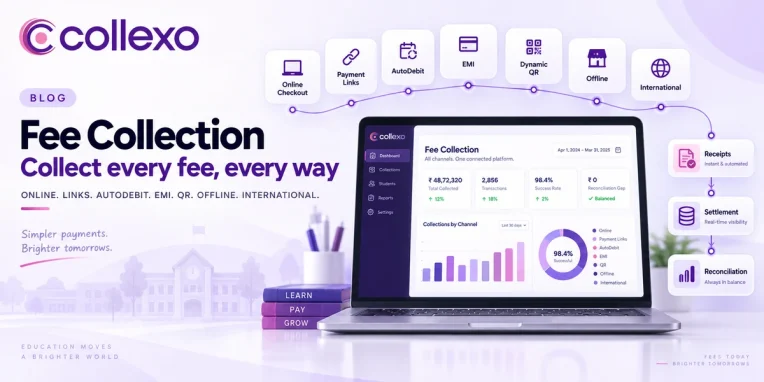
A strong fee collection process should make it easy for students and parents to pay while keeping every payment clear for the institution.
However, offering more payment methods is only one part of the job.
Educational institutions collect application fees, admission fees, tuition fees, hostel fees, transport fees, exam fees, programme fees, and many other charges. Students may also pay through different routes, from online checkout and payment links to AutoDebit, EMI, QR, offline payments, and international transfers.
When each payment route works separately, finance teams are left to connect the records later.
A better fee collection process connects the complete journey:
Fee Due → Payment Route → Collection → Student Record → Receipt → Settlement → Reconciliation
That is the difference between simply accepting payments and managing fee collection as one connected process.
Why does the fee collection process become difficult?
Most institutions do not have only one fee and one way to pay it.
A student may pay an application fee online today, an admission fee through a payment link next month, and tuition through AutoDebit after classes begin.
Meanwhile, another student may need EMI. A parent may walk into the campus and pay through UPI. International students may use a different payment route altogether.
The problem is not having several payment options.
The problem begins when those options create separate records.
For example, a payment may show as successful in the payment gateway, but the finance team may still need to identify the student, find the correct fee head, update the ledger, issue a receipt, and later check whether the amount was settled.
As payment volumes grow, this creates more follow-up work.
A connected process should therefore answer four questions automatically:
Who paid? What did they pay for? How did they pay? What happened after the payment?
1. Start every collection with the right fee context
Fee collection should not begin with a blank payment page.
It should begin with a clear fee demand.
That means the institution already knows the student, fee head, amount, and due date before the payment starts.
For example:
Aarav Mehta → Semester 2 Tuition → ₹45,000 → Due 15 September
Once that context exists, the institution can decide how the payment should be collected.
This is where fee management and collection need to work together.
With Collexo Fee Management, institutions can set up fee structures, schedules, instalments, scholarships, concessions, taxes, penalties, and reminders before the collection journey begins.
As a result, teams do not need to recreate the fee information when it is time to collect.
2. Give students more than one way to pay
Different payment journeys need different payment routes.
A parent paying a small application fee may prefer UPI. Someone clearing a large programme fee may want EMI. A finance team following up on an overdue balance may find a payment link more useful than asking the payer to return to a portal.
Therefore, institutions need flexibility.
With Collexo Fee Collection, institutions can collect fees through online checkout, payment links, AutoDebit, Dynamic QR, EMI, offline methods, and international payment channels.
However, adding more ways to pay should not mean creating more systems to manage.
Every payment route should lead back to the same student and fee record.
For example:
Student → Tuition Fee → Payment Link → Paid
or
Student → Examination Fee → UPI → Paid
The payment method changes. The financial context stays the same.
3. Make online checkout part of the student journey
Online payment is often the simplest route for application, admission, tuition, and other institutional fees.
Still, a generic checkout page only solves the payment step.
A better checkout already knows who is paying and what they need to pay.
The current Collexo Fee Collection flow connects online checkout with the student and applicable fee structure. It supports methods such as UPI, cards, net banking, and bank transfers, along with partial payments and fee-head splitting where configured.
This makes the journey clearer for both sides.
Students see the relevant payment request, while finance teams receive a transaction that already carries the right context.
4. Use payment links when the payment needs to come to the student
Not every payer will return to the student portal when a fee becomes due.
Sometimes the institution needs to take the payment journey to them.
For example, a student may have an overdue instalment. An applicant may need to pay an admission fee after speaking with the admissions team. A parent may simply need a direct way to complete a pending payment.
In these cases, payment links can reduce extra steps.
Collexo can send fee-payment links through channels such as WhatsApp, SMS, and email. Each link can be connected to the student, fee demand, fee category, and amount. Once payment is completed, the related payment record and student ledger can update accordingly.
So instead of asking the payer to find the correct fee again, the institution can send the right payment journey directly.
5. Automate recurring fee collection
Recurring fees can create recurring work.
Schools may collect tuition every month or quarter. Universities may use semester instalments. Coaching institutes may split programme fees across several due dates.
If teams have to send a fresh payment request and follow up before every instalment, the collection process quickly becomes repetitive.
Collexo AutoDebit connects an authorised eNACH mandate with the student’s recurring fee plan.
Institutions can configure the amount, payment frequency, fee heads, and debit dates. Eligible payments can then be initiated according to the fee schedule, while mandate status and collection outcomes remain connected to the student record.
As a result, finance teams can spend more time on failed or pending payments instead of manually managing every successful collection.
6. Give students an option for high-value fees
Some education fees are too large for every family to pay at once.
In those cases, limited payment flexibility can slow down fee completion.
EMI gives eligible students and parents another option.
With Collexo EMI, institutions can offer EMI within the same fee collection journey. Students can explore available repayment options, while successful EMI payments flow back into the institution’s fee collection records.
This keeps the journey connected:
Student → Eligible Fee → EMI Option → Payment → Fee Record
Therefore, EMI does not need to become a separate collection process that finance teams have to track elsewhere.
7. Connect campus counter payments too
Digital fee collection does not remove the need for a campus counter.
Students and parents may still visit an institution to pay an admission fee, clear an outstanding balance, or complete another payment in person.
However, a generic static QR can create another problem.
The institution may receive the money but still need to work out which student and fee the transaction belongs to.
Collexo Terminal uses a transaction-specific Dynamic QR connected to the student, fee head, and amount.
For example:
Student → Hostel Fee → ₹18,000 → Dynamic QR → Paid
Because the payment starts with the correct context, the transaction can be mapped back to the right student and ledger instead of becoming an unidentified payment that requires manual matching.
8. Do not leave offline payments outside the system
Digital payment methods are growing, but institutions still receive cash, cheque, demand draft, direct bank transfer, and other offline payments.
These transactions should not live in a separate spreadsheet simply because the payment happened offline.
Instead, they should be recorded against the same student and fee demand as online payments.
Collexo brings offline collections into the same Fee Collection layer, so teams can record the payment, link it to the learner, and generate the relevant receipt while keeping one fee history.
This gives finance teams a more complete view of collection, regardless of where the payment started.
9. Keep international payments connected
International fee collection introduces another set of details.
Students, parents, or sponsors may pay through international cards, bank transfers, or supported cross-border payment methods. Currency and payment references may also differ from domestic collections.
Still, the underlying question remains the same:
Which student and fee does this payment belong to?
Collexo supports international fee payment journeys while keeping the payment status connected to the relevant student, fee record, currency, payment reference, and settlement.
As a result, institutions can support international payers without creating a separate finance process for every cross-border transaction.
10. Map every successful payment automatically
A successful transaction should update more than a payment dashboard.
It should update the student record.
Suppose a student has ₹80,000 due and makes a ₹30,000 payment.
The institution needs more than this:
Transaction successful: ₹30,000
It needs:
Student → Fee Head → ₹80,000 Due → ₹30,000 Paid → ₹50,000 Balance
That connection makes the payment useful.
It also allows teams to answer student queries, track outstanding fees, generate accurate receipts, and understand the real collection position without manually matching separate files.
The current Collexo flow is built around this idea: create the fee demand, choose the payment route, collect and map the payment, then review and reconcile it.
11. Make reconciliation part of collection
The fee collection process should not end at a successful payment screen.
Finance teams still need to know whether the payment was settled and whether the financial records match.
For example, they may need to confirm the transaction status, settlement amount, bank credit, refund, reversal, or unmatched entry.
With Collexo Fee Payment Reconciliation, institutions can connect collection records with settlements and student ledgers.
Teams can track paid, pending, failed, settled, refunded, reversed, and unmatched transactions while moving from a high-level view to the student, programme, campus, or payment that needs attention.
Therefore, collection and reconciliation become one connected workflow rather than two separate finance tasks.
What should a connected fee collection process look like?
A strong process should connect:
- Create the fee demand: Define the student, fee head, amount, and due date.
- Choose the payment route: Use checkout, links, AutoDebit, EMI, QR, offline, or international collection.
- Collect and map: Connect every payment to the right student, fee, and ledger.
- Update the record: Reflect payment status, receipt, and outstanding balance.
- Track settlement: Follow the payment beyond the successful transaction.
- Reconcile and report: Match financial records and focus teams on exceptions.
The payment route can change from student to student.
The context should not.
From more payment methods to one connected collection process
Giving students and parents more ways to pay is important.
However, the real improvement comes when those payment methods stop creating separate workflows for the institution.
Online checkout should connect to the student record. Payment links should connect to the right fee. AutoDebit should follow the fee schedule. EMI should stay part of the same collection history. Counter payments should arrive already mapped. Offline and international payments should remain visible alongside digital collections.
Finally, every successful payment should move naturally into settlement and reconciliation.
That is how Collexo approaches fee collection.
One operating system for every fee collection and management.
With Collexo, institutions can collect every fee through every payment channel while keeping the student, fee, payment, settlement, and reconciliation journey connected from start to finish.