
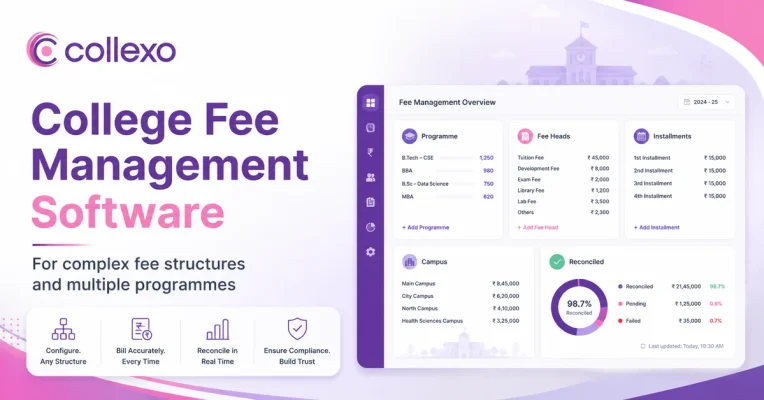
College fee management software handles the fee side of running a college or university. It configures fee structures, collects payments, and reconciles what comes in against what is owed. For institutions running several programmes at once, this is not optional. It is the only way to keep fee operations from collapsing into spreadsheets and manual follow-ups.
Most colleges do not run one fee structure. They run several, layered by programme, batch, and campus. A single spreadsheet cannot hold that complexity for long. As a result, finance teams end up patching gaps with manual reminders and end-of-month reconciliation marathons.
Why complex fee structures break generic systems
A university offering ten programmes across three campuses might have ten different tuition schedules, hostel charges that vary by campus, and scholarship rules that apply to some students and not others. Generic accounting tools were not built for this. They treat every student as a single line item.
This is where a proper college fee system earns its place. College Fee Management Software needs to hold multiple fee heads, such as tuition, hostel, mess, and exam fees, under one student record. It also needs to apply different billing cycles, since one programme might bill annually while another bills by semester. Without that flexibility, finance teams end up maintaining parallel trackers just to keep count.
How programme-wise fee configuration actually works
Programme fee management means setting up fee rules once per programme, batch, or specialisation, rather than once per student. This saves enormous manual effort at scale. A table makes the difference clear.
| Fee element | Manual spreadsheet approach | Programme-wise configuration |
|---|---|---|
| Tuition by programme | Separate sheet per programme, updated by hand | Configured once per programme, applied automatically |
| Hostel and mess fees | Tracked separately, prone to mismatches | Linked to student record as additional fee heads |
| Scholarships and waivers | Calculated manually per student | Auto-applied based on configured eligibility rules |
| Billing cycle | Fixed across the institution regardless of programme | Set independently per programme, semester, or year |
| Late fees | Applied inconsistently, often missed | Rule-based, applied automatically with grace periods |
Because of this structure, adding a new specialisation or intake does not mean rebuilding the fee process from scratch. A finance team configures the new programme once. The system applies it consistently after that.
Managing fees across multiple campuses and programmes
Multi-campus institutions add another layer. Each campus may have its own fee amounts, its own bank accounts for settlement, and its own local compliance requirements. Student fee management at this scale means the software has to route collections correctly without manual sorting.
Consider a university with a Delhi campus and a Bengaluru campus, each running undergraduate and postgraduate programmes. Fees collected at each campus need to settle into the correct bank account by fee head and department. In practice, this means GST splitting, since SGST, CGST, and IGST rates depend on the student’s domicile state and the fee category.
K.R. Mangalam University faced this exact challenge before consolidating its fee operations onto one platform. Its admissions team needed a single view of what was paid, what remained, and when, across every student and every mode of payment. That single-page view is what programme and campus-level configuration makes possible.
What a modern fee collection workflow looks like
Beyond configuration, the day-to-day collection workflow matters just as much. A student or parent should be able to pay through whichever mode they prefer, and the payment should reconcile itself without finance staff chasing receipts.
| Step | What happens | Manual effort required |
|---|---|---|
| Fee due date approaches | Automated reminder sent by WhatsApp, SMS, or email | None |
| Student pays | Payment accepted via UPI, card, net banking, or AutoDebit | None |
| Payment matches fee record | System reconciles payment to the correct student and fee head | None |
| Receipt generated | GST-compliant receipt issued instantly | None |
| Dues dashboard updates | Outstanding balance reflects in real time | None |
This means finance teams stop spending their time matching bank statements to student records. Instead, they spend it reviewing dashboards and following up only on genuine exceptions. That shift alone tends to free up significant staff hours during peak admission cycles.
Choosing the right college fee management software
Not every platform built for schools works for colleges and universities. Institutions evaluating options should look for a few specific capabilities. Programme and specialisation-level fee configuration is the first. Support for instalment plans assigned at the student or batch level is the second.
Multi-mode payment support matters too, covering UPI, cards, net banking, and recurring AutoDebit collection. Automatic GST computation across fee categories is essential for compliance, not a nice-to-have. Finally, real-time reconciliation and reporting should exist by default, not as a paid add-on configured after the fact.
Institutions running multiple programmes should also check whether the fee management layer supports government scheme integrations, such as SC, ST, OBC, or minority scholarship categories. These are common in Indian higher education and often get handled manually when the software does not support them natively.
How Collexo handles complex, multi-programme fee structures
Collexo is built specifically for this level of complexity. It configures fee structures by programme, batch year, and specialisation, with multiple fee heads under one student record and no coding required. Institutions can set semester, annual, or quarterly billing cycles independently across programmes.
On the fee collection side, Collexo supports UPI, cards, net banking, wallets, and AutoDebit through eNACH mandates, with automatic payment-link fallback if a mandate fails. Every payment reconciles in real time against the correct student and fee head, with GST computed and split automatically by category and domicile state.
For institutions weighing this level of platform against spreadsheets or generic accounting tools, the college fee payment and management system page walks through the full configuration, collection, and reconciliation workflow in more depth. Over 700 institutions currently run their fee operations on Collexo.
Want to see how this works for your institution’s specific programme structure? Book a demo and walk through your actual fee complexity with the Collexo team.