
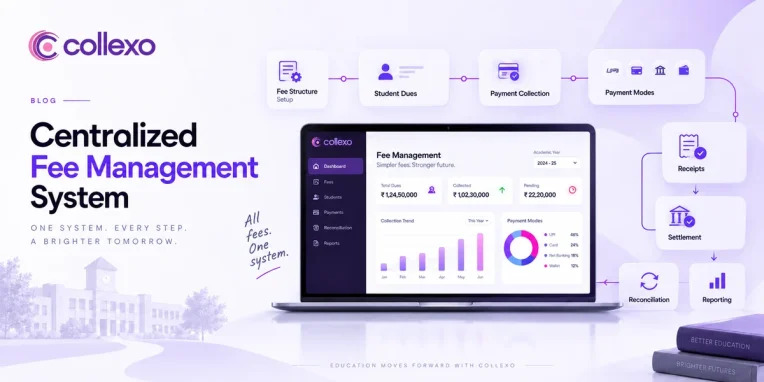
What should a centralized fee management system actually connect?
A centralized fee management system should do more than bring payment data into one dashboard.
For an educational institution, fee management starts before a payment is made and continues after the money reaches the bank.
First, teams need to decide what a student owes. Then, they need to collect that amount through the right payment mode. After payment, finance teams still need to update the student record, track the settlement, handle exceptions, and reconcile the transaction.
When these steps happen across different systems, teams may have all the data they need but still lack a complete view.
That is why centralization should mean more than putting reports in one place.
It should connect the complete fee journey.
Fee Setup → Student Dues → Collection → Payment Record → Settlement → Reconciliation → Reporting
For educational institutions, that connected flow is what turns separate fee processes into one operating system for every fee collection and management.
Why do fee operations become fragmented?
Fee operations rarely start fragmented.
Instead, they become fragmented as institutions add new programmes, campuses, payment methods, systems, and processes over time.
For example, one system may store fee structures. A payment gateway may process online payments. Another tool may manage recurring payments. Offline collections may sit in spreadsheets, while bank statements are used for reconciliation.
Each system solves a specific task.
However, finance teams still have to connect them.
A simple student payment may involve:
Student Record → Fee Structure → Amount Due → Payment Channel → Transaction → Receipt → Settlement → Bank Account
If any part of that chain sits separately, someone has to bring the information together later.
As payment volumes grow, this creates more manual work. It also makes basic questions harder to answer:
- What does this student still owe?
- Which fee did this payment cover?
- Has the amount been settled?
- Which campus or programme does it belong to?
- Was a refund processed?
- Why does the bank amount differ from the collected amount?
- Which transactions still need attention?
A centralized fee management system should make these answers easier to find because the records are already connected.
1. Connect fee setup with student dues
The first step is deciding what the student needs to pay.
However, education fees are rarely the same for every learner.
A university may have different fees by programme, semester, campus, or academic year. A school may add transport or activity fees for selected students. Meanwhile, another learner may receive a scholarship or concession.
Therefore, the system needs to manage more than a single total amount.
It should connect:
Fee Structure → Fee Heads → Schedule → Student → Amount Due
With Collexo Fee Management, institutions can set up fee structures, payment schedules, instalments, scholarships, concessions, taxes, penalties, reminders, and other fee rules.
More importantly, these rules remain part of the student’s fee record.
For example, if a ₹1,00,000 programme fee is split into four instalments, each instalment should have its own due date and payment status.
Similarly, if the student receives a scholarship, the revised amount should flow into the same fee record instead of being updated separately in another spreadsheet.
As a result, collection starts with an accurate view of what the student actually owes.
2. Connect every payment mode to the same fee record
Once the amount due is clear, the next question is how the student will pay.
Different students and parents prefer different payment methods.
One parent may pay through UPI. Another may use a card or net banking. A learner may need EMI, while another payment may happen through AutoDebit, an international payment route, or at the campus counter.
A centralized system should support this flexibility without creating separate financial records for every channel.
With Collexo Fee Collection, institutions can collect through online checkout, payment links, AutoDebit, EMI, dynamic QR, offline modes, and international payment channels.
The important part is not only offering more ways to pay.
It is keeping the payment context attached.
For example:
Riya Sharma → Semester 2 Tuition Fee → ₹35,000 → UPI → Paid
and
Arjun Mehta → Hostel Fee → ₹18,000 → Payment Link → Paid
Both transactions use different payment methods. Still, each payment stays connected to the correct learner and fee.
As a result, adding more ways to pay does not have to create more scattered payment records.
UPI supports instant bank-to-bank transfers as well as QR and intent-based payments. You can learn more about it from NPCI’s UPI overview.
However, payment infrastructure alone does not tell an institution what a payment means for the student’s dues.
That context has to come from the fee management system.
3. Keep the student ledger updated as payments happen
Collecting money is only one part of fee management.
The student record must also reflect what happened.
Suppose a student has three dues:
Tuition Fee: ₹60,000
Hostel Fee: ₹25,000
Examination Fee: ₹5,000
If the student pays ₹25,000, simply showing a successful ₹25,000 transaction is not enough.
Finance teams need to know which fee was paid.
Once that context is available, the student ledger can show what was charged, what has been paid, and what remains outstanding.
This creates a clearer view for both teams and payers.
For instance, finance teams can answer a student’s query without checking separate payment reports. At the same time, students and parents can see their dues, payment history, and receipts from the same fee journey.
Therefore, a centralized fee management system should connect payments directly with the student ledger instead of treating transactions as standalone entries.
4. Connect recurring payments with the fee schedule
Recurring fees create another challenge.
Schools may collect tuition every month or quarter. Universities may use semester-based instalments. Coaching institutes may collect programme fees across several scheduled payments.
Without a connected process, teams often send reminders manually and then track payments separately.
Instead, the collection schedule should follow the fee schedule.
Collexo AutoDebit connects an approved eNACH mandate with the student’s recurring fee plan.
For example:
₹12,000 monthly tuition fee → Due on the 5th → AutoDebit scheduled → Payment status updated
Once the mandate is approved, eligible payments can follow the configured schedule.
Meanwhile, every successful debit can stay linked to the student, fee head, receipt, and settlement record.
As a result, finance teams can focus on failed or pending collections instead of manually following up on every successful payment.
NACH provides the infrastructure for recurring and periodic electronic payments in India. Institutions can learn more about the framework through NPCI’s NACH information.
5. Connect campus payments to student records
Not every payment happens online.
Students and parents may still visit the campus to clear a fee or make an admission payment.
However, counter payments can create extra work when finance teams cannot quickly identify who made the payment or what the payment was for.
A better process starts with the student and fee context.
For example:
Student → Outstanding Hostel Fee → ₹15,000 → Dynamic QR → Payment
Instead of using the same QR for everyone, the payment request can be created against the specific student, fee head, and amount.
The payer then scans the QR and completes the payment.
Because the context exists before the transaction starts, the payment can stay connected to the correct student record.
As a result, finance teams have less manual payment mapping to do later.
Campus collection can also sit inside the same Collexo Fee Collection flow as online payments, payment links, AutoDebit, EMI, and other payment methods.
6. Connect payments with settlements
A student’s successful payment does not mean the finance process is finished.
The institution also needs to know what happened after the transaction.
For example, a student may pay ₹10,000. Finance still needs to confirm what amount was settled, which account received it, and whether the settlement matches the payment record.
Therefore, teams need visibility across:
Payment → Settlement → Bank → Student Record
Without that connection, finance teams often compare gateway reports, settlement files, bank statements, and student records manually.
With Collexo Fee Payment Reconciliation, institutions can connect student payments with settlements and the relevant fee records.
This makes it easier to answer questions such as:
- Was the transaction settled?
- Which settlement contained it?
- Does the payment belong to the right student?
- Does the amount match the correct fee?
- Is there an exception that needs attention?
- Is any payment still unmatched?
Instead of checking every transaction manually, teams can focus on the cases that actually need action.
As a result, reconciliation becomes part of the fee journey rather than a separate exercise at the end of the day or month.
7. Keep refunds, reversals, and other changes connected
Fee records do not always move in one direction.
Sometimes a payment fails. A student may pay twice. Another learner may withdraw from a programme. A hostel fee may need to be refunded. There may also be a reversal or excess payment.
These changes should not erase the original financial history.
For example, suppose a student pays ₹20,000 for hostel accommodation and later receives a ₹20,000 refund.
The system should preserve both events:
Original payment: ₹20,000
Refund: ₹20,000
The final amount may be zero, but the history still shows what happened.
That distinction is important for finance teams, students, and audits.
A refund should therefore be recorded as a new financial event linked to the original transaction rather than changing the original payment.
For a deeper look at this process, read our guide on fee refund management and student records.
A centralized fee management system should keep refunds, reversals, waivers, and other changes connected to the original student and payment records.
8. Bring multiple campuses and programmes into one view
Centralization becomes even more important as an institution grows.
A group may run several colleges, campuses, schools, departments, or branches. Each location may have its own fee structures, programmes, users, bank accounts, and collection targets.
Local teams need enough control to run their fee operations.
At the same time, the central finance team needs a wider view.
For example, leadership may want to see:
- Campus-level collections
- Programme-level outstanding dues
- Payment mode performance
- Settlement status
- Refunds and other exceptions
- Bank-wise collections
The answer should not require asking every campus to send a spreadsheet.
Instead, each location can manage its fee operations while finance teams get a connected view across the institution.
Collexo’s fee reconciliation and reporting capabilities let teams view collections across programmes, campuses, fee heads, payment modes, and settlement records.
This is where centralization creates more than convenience.
It gives finance teams both local detail and institution-wide visibility.
9. Turn connected records into useful reporting
A dashboard is only useful when the data behind it is connected.
If fee setup, payment records, settlements, and student ledgers come from separate sources, reporting can still require manual work.
However, when those records belong to the same fee journey, reports can answer more useful questions.
For example:
How much was due this month?
How much has been collected?
What remains outstanding?
Which payment channels are students using?
Which settlements are pending?
Where are the unmatched payments?
Which campus needs attention?
Finance teams can then move from a high-level number to the underlying programme, student, fee, payment, or settlement when needed.
Therefore, reporting becomes an outcome of connected fee operations rather than another process teams have to build manually.
What should you look for in a centralized fee management system?
Centralization should not simply mean putting several reports on one screen.
A useful system should connect what happens before, during, and after every payment.
Define the fee
Set up fee heads, schedules, instalments, scholarships, concessions, penalties, taxes, and due dates.
Assign the fee
Connect the right fee and rules to the student, programme, campus, or cohort.
Collect the fee
Give students and parents several ways to pay without creating separate payment records.
Update the student record
Keep dues, payments, balances, and receipts connected to the same student.
Track the settlement
See what was processed, settled, refunded, reversed, or remains unmatched.
Reconcile the payment
Match the money received with the right student, fee, transaction, settlement, and bank record.
Report on the complete journey
Give finance and leadership teams a clear view of collections, dues, settlements, and exceptions.
When these stages work together, teams spend less time connecting records after the fact.
One connected system for fee collection and management
The real problem with fragmented fee management is not that institutions use several payment methods.
Students and parents should have several ways to pay.
The problem begins when every payment method, student record, settlement, and report creates a separate version of the fee journey.
A centralized fee management system should remove those breaks.
Fee setup should connect to student dues. Student dues should connect to collection. Collection should update the student record. Payments should connect to settlements. Finally, reconciliation and reporting should use the same financial history.
That is the approach behind Collexo.
One operating system for every fee collection and management.
From deciding what a student owes to understanding what finally reached the institution, Collexo keeps the complete fee journey connected.
Explore Collexo Fee Management to see how institutions can bring fee setup, collection, reconciliation, and financial visibility into one connected system.